
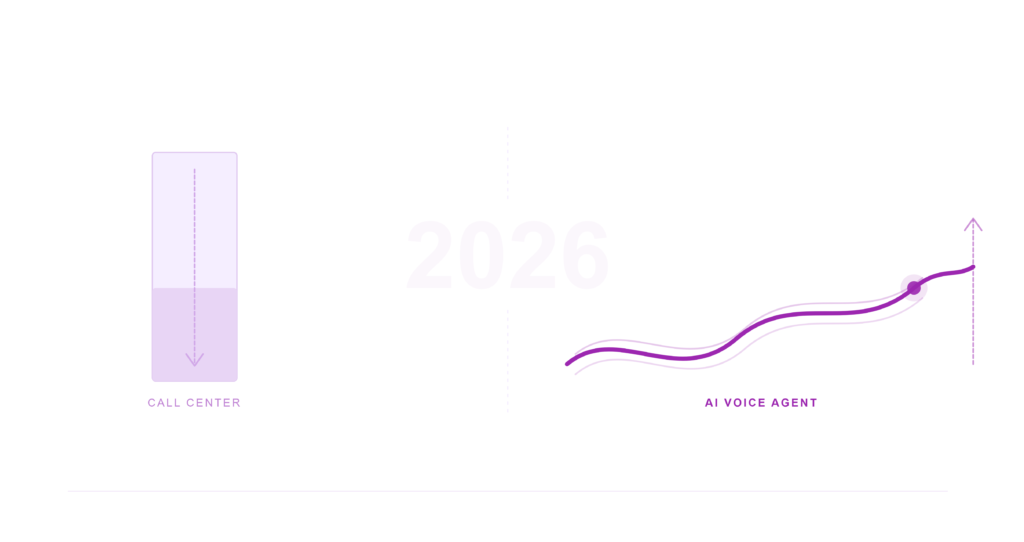
Customer service in the Kingdom is being rebuilt. Banks, telecoms, retailers, and government bodies are all under pressure to answer faster, in Arabic, around the clock, and without ballooning costs. That pressure is forcing one question into nearly every operations meeting: do we keep staffing rooms full of agents, or do we hand the phone to an AI voice agent?
This is not a theoretical debate anymore. Both models work in Saudi Arabia today, and each fits a different kind of business. Below is a straight comparison, written for the people who actually have to make the call.
The short answer first
For high-volume, repetitive calls in Arabic, an AI voice agent costs less, answers instantly, and never goes off-shift. For complex, sensitive, or emotionally charged conversations, trained human agents still win. Most Saudi companies that get this right end up running both: AI on the front line, people on escalation. The rest of this article explains why, and how to decide where your business lands.
Why this is happening now in Saudi Arabia
Three forces are pushing the change at the same time.
Vision 2030 made digital service quality a national priority, not a nice-to-have. Customers now compare a bank’s call experience to the best app they used that morning. The bar moved.
Arabic-capable AI finally got good. For years, voice automation in the region meant clunky English-first systems bolted onto an Arabic menu. That era is ending. Speech models now handle Saudi dialects with enough accuracy to hold a real conversation.
And cost matters more than ever. Saudization targets, rising wages, and 24/7 service expectations make a fully human contact center expensive to staff and harder to scale during demand spikes like Hajj, Ramadan, and major sales events.
What a traditional call center actually is
A traditional call center runs on people. Agents work shifts, follow scripts, escalate to supervisors, and handle calls one at a time. In Saudi Arabia these teams power banking support lines, telecom help desks, government service hotlines, and retail customer care.
What they do well is judgment. A skilled agent reads tone, calms an upset customer, handles a request that doesn’t fit any script, and knows when to bend a rule. That human read of a situation is something software still struggles to match.
The limits are practical. Agents cost money per seat, per shift, per hour of training. Quality drifts between a strong agent and a tired one at 3 a.m. Hold times balloon when call volume spikes. And scaling up for a busy season means hiring and training people weeks in advance, then paying for them after the rush ends.
What an AI voice agent actually is
An AI voice agent answers calls and speaks back in a natural voice. It listens through speech recognition, understands intent through language models, and responds in real time. It can pull a customer’s account, confirm a delivery, reset a service, book an appointment, or pass the call to a human when it hits its limit.
The part that matters most in this market is Arabic. A voice agent built for global English and patched for Arabic will frustrate Saudi callers within seconds. One built for the region handles the way people actually speak.
This is the gap Ehlan.ai was built to close. It understands Najdi, Hijazi, Khaleeji, Egyptian, and Modern Standard Arabic, and it follows a caller who switches between Arabic and English in the middle of a sentence the way many Saudis naturally do. It handles inbound and outbound calls, and it connects into the systems a business already runs on, including CRMs, WhatsApp, and existing telephony.
That combination, native dialect handling plus real system integration, is what separates a voice agent that callers trust from one they hang up on.
The head-to-head comparison
Cost. A call center charges you per agent, per shift, indefinitely. An AI voice agent carries a setup cost, then a low cost per call after that. For repetitive, high-volume work, the per-call economics are not close.
Availability. Human teams work shifts and need breaks, holidays, and night premiums. An AI agent answers at 3 a.m. on Eid with the same speed as 10 a.m. on a Tuesday.
Language and dialect. This is where most generic automation fails in the Kingdom. A caller speaking Najdi or switching to English mid-sentence expects to be understood. A regionally built agent like Ehlan.ai handles that. A translated foreign system does not.
Scaling for peak demand. Hajj, Ramadan, and big promotions can multiply call volume overnight. Adding human capacity takes weeks. An AI agent absorbs the spike instantly and costs nothing extra when the spike ends.
Consistency. Every AI call follows the same standard. Human quality naturally varies by agent, by mood, and by hour.
Complex and emotional calls. Here humans lead. A frustrated customer, a sensitive complaint, or a request with no clear script is still best handled by a trained person.
Compliance. Saudi Arabia’s Personal Data Protection Law sets clear rules on how customer data is handled. Any serious deployment, human or AI, has to meet them. This is a requirement to confirm with any vendor, not a feature to assume.
The cultural side, which decides more than people expect
Language accuracy is not just a technical spec in Saudi Arabia. It is a trust signal. A caller who is understood in their own dialect relaxes. A caller forced to repeat themselves to a system that clearly was not built for them loses faith fast and asks for a human, which defeats the point.
Acceptance of AI service is rising, but it is earned per call. The first ten seconds decide whether the customer cooperates or resists. Dialect fluency, natural phrasing, and a smooth handoff to a person when needed are what build that acceptance.
This is why a regionally built agent matters more here than in many other markets. The technology has to sound like it belongs.
Where each model fits, by industry
Banking and fintech. AI handles balance checks, card activation, and routine queries instantly. Humans take fraud disputes and sensitive financial decisions.
Telecom. AI manages plan changes, top-ups, and outage reports at high volume. Agents handle billing disputes and retention.
E-commerce and retail. AI confirms orders, tracks deliveries, and processes returns, inbound and outbound, including order-status calls and proactive delivery updates.
Government and public services. AI answers high-frequency citizen questions in clear Arabic, freeing staff for cases that need real judgment.
Healthcare. AI books, confirms, and reminds patients of appointments, cutting no-shows without adding clinic staff.
The hybrid model most winners actually use
The smartest deployments in the Kingdom do not pick one side. They route every call to AI first. The agent resolves what it can, which is usually the majority of tier-one volume, and escalates the rest to a human with the context already gathered.
In practice this looks like Ehlan.ai answering inbound calls, resolving routine requests, and passing the genuinely complex ones to a human agent without making the customer start over. Outbound, the same agent handles confirmations, reminders, and follow-ups that would otherwise eat hours of staff time.
The result is a smaller, sharper human team doing the work that needs people, sitting on top of an AI layer that handles the volume. Cost drops, wait times shrink, and the human agents spend their day on cases worth their skill.
The honest challenges
No model is free of trade-offs.
Dialect accuracy, while strong, is not flawless across every accent and edge case, which is exactly why a clean human handoff matters.
Integration with older systems takes work. A voice agent is only as useful as its connection to the CRM and telephony behind it.
Workforce concerns are real. The practical path is redeployment, moving agents from repetitive call-handling to higher-value support, rather than blunt replacement, which also fits Saudization goals better.
And there is an upfront investment before the per-call savings show up. The return is real, but it is not instant.
Where this is heading
Arabic-native voice AI will keep improving, and the gap between a translated foreign system and a regionally built one will widen, not close. Saudi businesses that adopt early are building the operational habit while competitors are still debating it. Within a few years, an Arabic AI voice agent on the front line will be the default expectation, the way a mobile app became the default a decade ago.
How to decide for your business
Ask three questions. What share of your calls are repetitive and rule-based? If it’s high, AI pays for itself fast. Do your callers speak in dialect and switch languages? Then a regionally built agent is non-negotiable. And how badly do peak seasons hurt your current setup? The worse the spikes, the stronger the case for automation that scales instantly.
If the answers point toward automation, the practical next step is to hear it for yourself. You can book a demo on the Ehlan.ai website, or talk directly to the live AI voice agent running there and judge the Arabic dialect handling firsthand, which tells you more in two minutes than any specification sheet.
FAQs
Do AI voice agents understand Saudi dialects?
Yes, if the agent is built for the region. Ehlan.ai handles Najdi, Hijazi, Khaleeji, Egyptian, and Modern Standard Arabic, and follows callers who switch between Arabic and English mid-sentence. Generic global systems patched for Arabic usually fail this, which is why dialect support should be tested before anything else.
Are AI voice agents cheaper than a call center?
For repetitive, high-volume calls, clearly yes. A call center costs you per agent, per shift, indefinitely. An AI agent has a setup cost, then a low cost per call. The savings are largest on routine work and during peak seasons when human teams are hardest to scale.
Can an AI voice agent fully replace human agents?
No, and it shouldn’t. AI handles routine, rule-based calls well. Complex disputes, sensitive complaints, and emotional conversations still need trained people. Most successful Saudi deployments run a hybrid: AI on the front line, humans on escalation.
Can it handle busy seasons like Hajj and Ramadan?
Yes. An AI agent absorbs sudden call spikes instantly and costs nothing extra once the rush ends. Scaling a human team for the same surge takes weeks of hiring and training, then leaves you overstaffed afterward.
Does it work 24/7?
Yes. There are no shifts, breaks, or night premiums. An AI voice agent answers at 3 a.m. on Eid as quickly as midday on a weekday.
Will it integrate with our existing systems?
Ehlan.ai connects to CRMs, WhatsApp, and existing telephony, and handles both inbound and outbound calls. A voice agent is only as useful as its connection to the systems behind it, so integration is a key thing to confirm during setup.
Is customer data handled in line with Saudi regulations?
Saudi Arabia’s Personal Data Protection Law (PDPL) sets clear rules for handling customer data, and any serious deployment must meet them. Confirm data handling and compliance directly with your vendor before going live.
How do we know if our business is a good fit?
Ask three questions: What share of your calls are repetitive? Do callers speak in dialect or switch languages? How badly do peak seasons strain your current setup? The more those point toward high volume and seasonal spikes, the stronger the case for an AI voice agent.
How can we try it?
You can book a demo on the Ehlan.ai website, or talk directly to the live AI voice agent running there to judge the Arabic dialect handling yourself.

As a writer for the Ehlan.ai blog, Hassan connects marketing strategy with AI voice technology. He helps business leaders learn how to attract, engage, and win customers in a world where automation gives companies the edge. His articles come from real campaign experience, deep knowledge of the region, and a clear view of how AI is changing the way brands talk to customers.
When he is not writing, Hassan follows the latest news from Riyadh's fast growing AI and tech scene and shares the most useful insights with the Ehlan.ai community
- AI Voice Agents for Real Estate Lead Qualification - September 27, 2026
- LEAP 2026 Saudi Arabia Review: What Really Happened and What It Means for Your Business - September 10, 2026
- Ehlan.ai AI Voice Agents vs Human Receptionists: Cost Comparison in KSA - September 6, 2026