
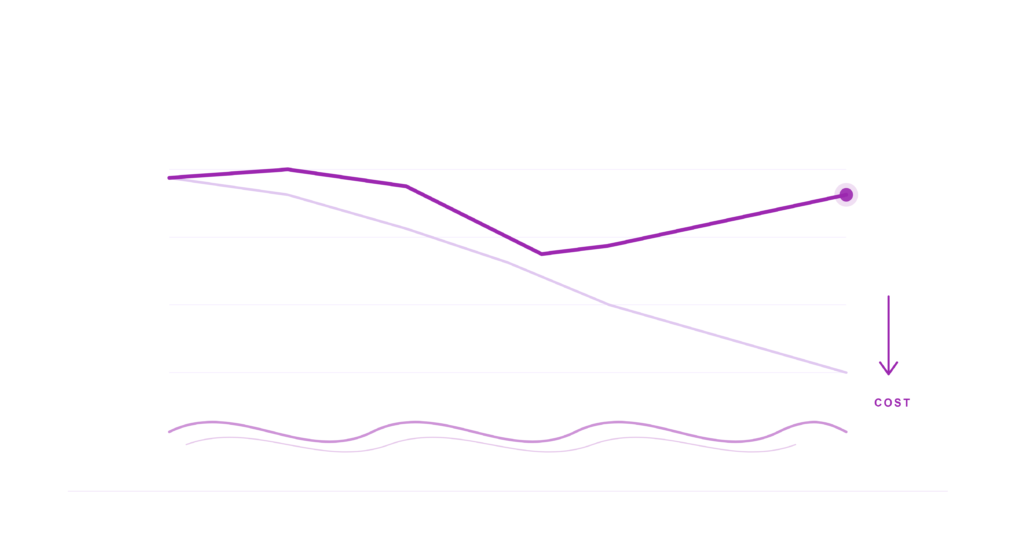
You budget 4,000 SAR for a receptionist. By the time you add iqama fees, housing allowance, transport, and overtime, you are paying over 6,000 SAR. Then your agent calls in sick on your busiest day, and your customers wait on hold until they hang up and call your competitor instead.
This is not a Saudi Arabia problem. It is a global business problem. And in 2026, thousands of companies worldwide are solving it with AI voice agents.
A traditional human agent handles one call at a time, works eight hours a day, and costs between 26 and 45 SAR per call when you account for salary, training, benefits, and overhead. An AI voice agent handles unlimited simultaneous calls, works 24 hours a day, and costs as little as 0.80 SAR per minute with Ehlan.ai. On a typical 3-minute call, that is 2.40 SAR total. That is not a small difference. That is a complete rethinking of how customer communication works.
This article breaks down exactly how AI voice agents reduce operational costs, which businesses benefit most, what the real numbers look like, and how companies in Saudi Arabia are already using tools like Ehlan.ai to automate their customer calls without losing the human touch customers expect.
What Is an AI Voice Agent?
An AI voice agent is a software system that can hold full, natural phone conversations with customers. It listens, understands what the caller is saying, and responds in real time, without any human involvement.
These are not the old-style phone menus where you press 1 for billing and press 2 for support. Modern AI voice agents understand natural speech, handle follow-up questions, manage objections, book appointments, process orders, and escalate to a human agent when the situation genuinely requires one.
The core technologies that make this possible include:
Natural Language Processing (NLP): The system understands what the caller means, not just what they say. It handles different accents, colloquial expressions, and indirect questions.
Automatic Speech Recognition (ASR): Converts spoken words into text that the AI can process, with accuracy rates above 95% on modern platforms.
Text-to-Speech (TTS): Converts the AI’s response back into natural-sounding speech. Voice cloning technology now makes these voices sound indistinguishable from a trained human agent.
Large Language Models (LLMs): The brain of the operation. LLMs allow the agent to understand context, remember what was said earlier in the call, and generate responses that feel genuinely conversational.
System Integrations: Modern AI voice agents connect to your CRM, calendar, ticketing system, and other tools, so they can actually complete tasks, not just answer questions.
The Real Cost of Human Call Agents: What Most Businesses Miss
Before we look at the savings AI delivers, it helps to understand the full cost of human agents. Most business owners look at the monthly salary and stop there. That is the wrong number.
Here is what a contact center agent actually costs in 2026:
Base salary: This is the number on the offer letter.
Benefits and payroll taxes: Add 25 to 35 percent on top of base salary for employer contributions, health insurance, and paid time off.
Recruitment and hiring: Industry estimates put the cost of recruiting and onboarding a new agent at 15 to 20 percent of annual salary.
Training: Initial training for customer-facing roles typically runs 2 to 4 weeks, during which the agent is paid but not productive.
Turnover: Contact center agent turnover runs as high as 60 percent annually. That means you are hiring and training a fresh team almost every two years, paying that 15 to 20 percent recruitment cost over and over.
Supervision and quality assurance: You need team leads, quality managers, and trainers whose salaries exist purely to manage the agents.
Infrastructure: Phones, headsets, software licenses, desk space, internet, electricity.
When you add all of this together, the per-call cost for a human agent in a Saudi business sits between 25 and 45 SAR per call when salary, iqama, housing allowance, transport, training, and supervision are all factored in.
Contrast that with Ehlan.ai: 0.80 SAR per minute. A typical 3-minute customer call costs 2.40 SAR. Even a longer 5-minute call comes to just 4 SAR. You are not comparing slightly different prices. You are comparing a fundamentally different cost structure.
That is an 85 to 95 percent reduction in cost per interaction.
7 Specific Ways AI Voice Agents Cut Operational Costs
1. Eliminating After-Hours Staffing Costs
Every business gets calls outside business hours. Most businesses either miss those calls or pay a premium to staff an after-hours team.
AI voice agents are available 24 hours a day, 7 days a week, including weekends and public holidays, at no additional cost. There is no night-shift premium, no overtime pay, and no call that goes to voicemail because everyone went home.
For Saudi businesses, this is particularly relevant. National Day, Eid Al-Fitr, Eid Al-Adha, and other public holidays see some of the highest customer call volumes of the year, but they also see the highest staff absenteeism. An AI agent does not take holidays.
One business using AI voice agents saved $47,000 in a single holiday season by replacing expensive temporary hires with automated coverage.
2. Handling High Call Volumes Without Hiring
Traditional staffing models are reactive. When call volume spikes, you hire more agents. When it drops, you have idle staff. This mismatch between supply and demand is one of the most expensive inefficiencies in customer service.
AI voice agents scale instantly. Whether you receive 10 calls or 10,000 calls in an hour, the AI handles every one simultaneously. There is no queue, no hold time, and no missed call because the line was busy.
This elasticity removes the need for buffer staffing, which is the practice of keeping extra agents on the payroll just in case volume spikes. For a team of 20 agents where 5 are typically buffer staff, eliminating that buffer represents a 25 percent reduction in staffing costs with zero reduction in service capacity.
3. Reducing the Cost of Routine and Repetitive Inquiries
Studies show that 45 to 70 percent of calls to most businesses are routine. Order status. Appointment scheduling. Account balance. Operating hours. Return policies. Frequently asked questions.
These calls do not require human judgment. They require information access and a pleasant tone. An AI voice agent handles them perfectly while freeing your human team to focus on complex issues that genuinely require expertise.
If your team handles 1,000 calls per month and 600 of those are routine, automating those 600 calls means your human agents spend 100 percent of their time on the 400 calls where they actually add value. Your customers get better service on complex issues, and you pay less per interaction overall.
4. Cutting Training and Onboarding Costs
A new human agent needs weeks of training before they can handle customer calls confidently. Even then, their first months involve mistakes, escalations, and coaching sessions that cost supervisory time.
An AI voice agent is trained on your business once. You feed it your product information, your common scenarios, your tone guidelines, and your escalation rules. It goes live in hours and does not make training-phase errors. When your business changes, you update the AI’s knowledge base once, and every call going forward reflects the update. There is no re-training for each agent individually.
For fast-growing businesses or those with high seasonal turnover, this is a major cost driver removed from the equation.
5. Eliminating Errors That Cost Money
Human agents make mistakes. They give wrong information, forget to log a call in the CRM, misquote a price, or promise a delivery date they cannot deliver. These errors have downstream costs: refunds, escalations, repeat calls, and customer churn.
AI voice agents follow your defined workflows consistently on every single call. They do not have bad days. They do not mishear and provide wrong information because they were distracted. Every call is logged automatically, every piece of information given is from your approved knowledge base, and every action taken in your systems is recorded.
According to McKinsey, companies that implement AI-driven automation in customer engagement can reduce operational costs by up to 40 percent while improving customer satisfaction scores by 25 percent or more. The error reduction is a significant part of that equation.
6. Reducing Cost Per Lead and Improving Conversion
Sales teams waste enormous amounts of time calling leads who are not ready to buy, leaving voicemails that are never returned, and following up manually on inquiries that came in overnight.
AI voice agents handle outbound lead follow-up instantly, at scale, and in any language. A lead fills out a form on your website at 2 AM. The AI calls them within seconds, qualifies their interest, answers initial questions, and books a meeting with your sales team, all before a human agent arrives at the office in the morning.
The speed advantage alone is significant. Research shows that responding to a lead within 5 minutes increases conversion rates by 9 times compared to a 10-minute response. AI achieves this for every single lead, every hour of the day.
7. Lowering Customer Churn Through Faster Resolution
Every minute a customer waits on hold is a minute they consider switching to a competitor. A Zendesk study found that 50 percent of customers will switch to a competitor after just one bad experience, and long wait times rank among the most cited bad experiences.
AI voice agents eliminate hold time entirely. The customer calls, the AI answers instantly, and if the issue is resolvable without a human, it is resolved in that call. Faster resolution means higher customer satisfaction, and higher customer satisfaction means lower churn.
Research shows that even a 5 percent increase in customer retention can boost profits by 25 to 95 percent. Reducing churn through better call handling is not just a cost reduction story. It is a revenue growth story.
What the Numbers Actually Look Like: ROI Breakdown
Here is a straightforward cost comparison for a Saudi business handling 3,000 customer calls per month, with an average call length of 4 minutes:
Human Agent Model (Saudi Arabia):
- 3 full-time agents at 4,000 SAR/month base each = 12,000 SAR/month
- True total per agent (iqama, housing, transport, insurance) = approx. 6,000 SAR x 3 = 18,000 SAR/month
- Management and supervision = 5,000 SAR/month
- Infrastructure (phones, software, office space) = 3,000 SAR/month
- Training and turnover costs (amortized) = 2,000 SAR/month
- Total: approximately 28,000 SAR/month
- Cost per call: 9.33 SAR
Ehlan.ai Model:
- 3,000 calls x 4 minutes average = 12,000 minutes/month
- 12,000 minutes x 0.80 SAR = 9,600 SAR/month
- 1 human agent for complex escalations = 6,000 SAR/month
- Total: approximately 15,600 SAR/month
- Cost per minute: 0.80 SAR (fixed, predictable, no surprises)
Monthly savings: approximately 12,400 SAR Annual savings: approximately 148,800 SAR
And that is a conservative estimate. It does not account for after-hours calls that currently go unanswered, leads that convert because the AI followed up instantly, or the hidden cost of turnover when staff leave.
Most businesses using Ehlan.ai achieve payback on their investment within 60 to 90 days. After that, every month represents compounding operational savings.
Forrester Consulting found that companies deploying AI voice agents report a three-year ROI between 331 and 391 percent. Gartner predicts that conversational AI will eliminate $80 billion in contact center labor costs globally in 2026 alone.
Which Industries Benefit Most
AI voice agents deliver value across virtually every industry, but certain sectors see outsized returns:
Healthcare and Medical Clinics
Appointment scheduling, prescription refill reminders, test result inquiries, and insurance verification are among the most common calls to healthcare facilities. All of them are routine. All of them can be fully automated. A clinic that books 200 appointments per week and currently employs two receptionists can handle that same volume with one AI agent and redirect staff to in-person patient care.
Real Estate and Property Management
Property inquiries, viewing scheduling, lease renewal reminders, and maintenance request logging are all highly automatable. Real estate businesses that use AI voice agents for initial lead qualification report significant reductions in the number of showings that go nowhere, because the AI screens for serious buyers before a human agent invests time.
Banking and Financial Services
Balance inquiries, transaction confirmations, fraud alerts, and appointment booking for loans or account reviews are handled smoothly by AI voice agents. Saudi Arabia’s banking sector has seen particularly strong adoption, with one major bank reporting an 85 percent reduction in wait times and 40 percent cost savings after deploying AI voice agents.
Retail and E-Commerce
Order tracking, return processing, delivery updates, and product availability checks account for the majority of retail customer service calls. All are ideal for automation. BuyaCar introduced conversational AI and achieved a 33 percent drop in call abandonment rates, directly reducing lost sales.
Hospitality and Travel
Reservation confirmation, check-in information, room upgrade inquiries, and local recommendations are all handled effectively by AI voice agents, freeing hotel staff to focus on in-person guest experience.
Telecommunications
Bill inquiries, plan changes, technical troubleshooting first steps, and account modifications are high-volume, process-driven calls that AI handles at a fraction of the human cost.
The Saudi Arabia Context: Why AI Voice Agents Are Especially Valuable Here
Saudi Arabia is one of the fastest-growing markets for AI adoption in the world. According to IMARC Group, the Saudi conversational AI market reached $158.8 million in 2025 and is projected to grow to $1.66 billion by 2034, a compound annual growth rate of 29.8 percent.
This growth is driven by several unique factors:
Vision 2030 Digital Transformation: The Saudi government has made AI adoption a national priority. Businesses that invest in AI technology today are aligning with a broader national strategy that includes government incentives, digital infrastructure investment, and regulatory support for innovation.
The Arabic Language Challenge: Most global AI voice platforms are built for English. A customer calling a business in Riyadh or Jeddah expects to be served in Arabic, ideally in the Saudi dialect they use every day, not a formal Modern Standard Arabic that feels formal and distant. Businesses that deploy generic English-first AI tools in the Saudi market often see poor adoption and customer frustration.
High Labor Costs for Skilled Bilingual Staff: Employees who can serve customers professionally in both Arabic and English are in high demand and command premium salaries. AI voice agents that handle both languages fluently multiply the value of human teams without multiplying the headcount.
SMB Growth: Saudi Arabia’s small and medium businesses are growing rapidly, but many cannot afford to hire full customer service teams at the quality level their customers expect. AI voice agents allow a 10-person company to deliver enterprise-level responsiveness.
Cultural Expectations Around Speed: Saudi customers expect fast responses. Waiting 4 to 12 hours for a callback on a WhatsApp inquiry is increasingly unacceptable in a market where competitors are deploying instant AI responses.
Introducing Ehlan.ai: Saudi Arabic Voice AI Built for Your Business
For businesses in Saudi Arabia, finding an AI voice agent that genuinely understands Saudi dialect, integrates with local business workflows, and goes live without a lengthy IT project is what separates a useful tool from an expensive experiment.
Ehlan.ai was built specifically for this market.
Unlike generic international platforms that offer Arabic as a secondary language with limited dialect support, Ehlan.ai handles Saudi Arabic natively. Its AI agents understand local expressions, common business scenarios, and the cultural context that shapes how Saudi customers communicate.
Here is what Ehlan.ai delivers in practice:
Instant Call Answering: Every incoming call is answered immediately, 24 hours a day, in the caller’s preferred language. No hold music, no voicemail, no missed opportunity.
Saudi Dialect Understanding: The AI recognizes and responds naturally in Saudi Arabic, eliminating the misunderstandings that occur when customers speak in dialect to an agent trained only on formal Arabic.
Lead Qualification and Booking: WhatsApp leads and website inquiries are followed up instantly. The AI qualifies the prospect, answers their initial questions, and books a meeting or demo with your sales team, often before your team starts their working day.
Omnichannel Coverage: Ehlan.ai handles calls, WhatsApp messages, and SMS from a single platform, giving you one place to manage all customer communication.
Fast Setup: From signing up to live AI calls takes hours, not weeks. You do not need an IT department or a development team. You configure the agent’s voice, personality, and knowledge base through a straightforward setup process.
Simple, Transparent Pricing: Ehlan.ai charges 0.80 SAR per minute of conversation. No hidden fees, no per-seat licenses, no monthly minimums that punish you during slow months. A 4-minute call costs 3.20 SAR. A busy month with 3,000 calls averaging 4 minutes costs 9,600 SAR in AI time. Compare that to 28,000+ SAR for the human team doing the same volume. Businesses using Ehlan.ai typically reduce their customer service costs by 40 to 70 percent within the first 90 days.
For a small clinic in Riyadh that currently pays 6,000 SAR per month for a receptionist who works 9 to 5 six days a week, Ehlan.ai handles every call, including nights, weekends, and Eid, at 0.80 SAR per minute, without ever putting a patient on hold. Even at 500 minutes of call time per month, that is 400 SAR total versus 6,000+ SAR for the human alternative.
If you want to see what it sounds like when your business gets an AI agent that speaks your customers’ dialect and knows your business, Ehlan.ai offers a 15-minute session to review your use case and show you a live demo with your actual call scenarios.
Addressing the Common Concerns
“Will customers notice they are talking to an AI and feel put off?”
This is the most common concern, and it is legitimate. The answer depends on the quality of the AI and how it is deployed.
Poorly implemented AI agents are easy to spot: robotic voices, rigid scripts, inability to handle anything outside a narrow set of questions. These create frustration.
Well-implemented AI agents with high-quality voice synthesis, natural language understanding, and clear escalation pathways for complex issues are experienced by most customers as fast, efficient service. Research from DesignVeloper shows that AI voice agents can provide consistent, personalized, and empathetic responses that customers respond well to. The key is clear escalation: customers accept AI handling routine tasks as long as they know a human is reachable for anything complex.
A 2023 survey found that 87 percent of UAE consumers preferred human agents for complex or sensitive issues. Note what that means: they prefer AI for everything else. That “everything else” is where the cost is.
“What happens when the AI cannot handle a call?”
Every responsible AI voice agent deployment includes clear escalation pathways. When the AI encounters a situation outside its training, it smoothly transfers the call to a human agent along with a summary of what was discussed. The human picks up with full context, the customer does not have to repeat themselves, and the interaction continues seamlessly.
The best AI systems also learn from escalations over time, identifying patterns in calls that the AI could not handle and improving accordingly.
“Is our customer data safe?”
Data security is a genuine consideration, not a minor footnote. Any AI voice agent platform you choose should comply with Saudi Arabia’s Personal Data Protection Law (PDPL), operate from compliant data centers, and provide clear audit trails of all interactions.
When evaluating any platform, ask specifically about PDPL compliance, data residency, and how call recordings and transcripts are stored and protected.
“Does it work for our industry’s specific needs?”
AI voice agents are not one-size-fits-all out of the box. The best platforms allow you to train the agent on your specific business: your products, your pricing, your common questions, your tone, and your escalation scenarios. An agent configured for a medical clinic works very differently from one configured for a real estate office, and that is exactly how it should be.
How to Evaluate an AI Voice Agent for Your Business
Before committing to any platform, work through these questions:
Call volume and complexity: How many calls do you receive per month? What percentage are routine versus complex? Higher routine call volume means faster ROI.
Language requirements: Do your customers call in Arabic, English, or both? Does the platform genuinely handle your market’s dialect, or does it offer only formal Modern Standard Arabic?
Integration needs: Does the AI connect to your existing calendar, CRM, or ticketing system? An AI that can only talk but not act on your systems is significantly less valuable.
Setup time and technical requirements: How quickly can you go live? Do you need a development team, or is the platform designed for business owners to configure themselves?
Pricing structure: Understand the full cost, including any per-minute fees, platform subscription, integration costs, and support costs. Compare this to your current per-call cost.
Escalation handling: How does the AI handle calls it cannot resolve? Is the handoff to a human agent smooth and does it preserve the context of the call?
Compliance and security: Is the platform compliant with local data protection laws? Where is data stored?
Trial or demo availability: Can you hear the AI handling your specific use case before you commit?
Getting Started: A Practical Path Forward
Moving from a fully human-staffed customer service operation to an AI-augmented one does not require a massive transformation project. Most businesses start with one use case, prove the value, and expand from there.
Step 1: Identify your highest-volume routine calls. Look at your call logs for the past 90 days. What are the top 10 questions callers ask? How many calls could have been resolved without a human agent?
Step 2: Choose a platform built for your language and market. For Saudi businesses, this means choosing a platform with genuine Saudi Arabic dialect capability, not just a translation layer on top of an English-first system.
Step 3: Start with inbound call handling. Configure the AI for your most common scenarios. Go live. Monitor how the AI performs and where it escalates.
Step 4: Review your numbers after 30 days. How many calls did the AI handle? What was the containment rate (percentage resolved without escalation)? How does the cost per call compare to your previous baseline?
Step 5: Expand based on results. Once you have proven value on inbound calls, add outbound lead follow-up, WhatsApp automation, or appointment reminders.
The businesses that see the fastest ROI are the ones that start simple and expand deliberately, rather than trying to automate everything at once.
Conclusion
The economics of AI voice agents are no longer theoretical. Gartner predicts that by 2029, agentic AI will autonomously resolve 80 percent of common customer service issues. Voice agent usage grew nine times in 2025 alone. The contact centers and customer communication teams that will dominate their markets in 2028 are being built right now, with AI at their core.
For businesses in Saudi Arabia, the opportunity is even more specific. Saudi Arabia is one of the most AI-forward markets in the Arab world, driven by Vision 2030, significant government investment, and a young population that expects digital-first experiences. The businesses that move now build a customer communication capability that compounds in value over time. The ones that wait face competitors who are already serving customers faster, at lower cost, and in better Arabic.
AI voice agents do not replace the human relationships that build loyal customers. They handle the routine interactions that currently cost you money and prevent your best people from doing meaningful work. That is not automation for automation’s sake. That is a smarter allocation of every resource your business has.
If you are ready to see what this looks like for your specific business, Ehlan.ai offers a 15-minute consultation that walks through your use case, calculates your ROI, and lets you hear a live AI agent handling your real call scenarios, in Saudi Arabic, right now.
Frequently Asked Questions
How much do AI voice agents cost?
Pricing varies by platform. Ehlan.ai, built specifically for Saudi Arabia, charges 0.80 SAR per minute of conversation. A typical 3-minute customer call costs 2.40 SAR. Compare that to the true cost of a human agent in Saudi Arabia, which runs 25 to 45 SAR per call once salary, iqama, housing, and overhead are included. Most businesses using Ehlan.ai save 85 to 90 percent on their per-call cost.
How long does it take to set up an AI voice agent?
Modern platforms can be configured and go live within hours for standard use cases. More complex implementations with custom integrations typically take a few days to a week.
Can AI voice agents handle Arabic?
Yes, but quality varies significantly across platforms. Some platforms offer formal Modern Standard Arabic. Others, like Ehlan.ai, are specifically trained on Saudi Arabic dialect, which produces more natural and effective conversations with Saudi customers.
What is a good containment rate for an AI voice agent?
A containment rate is the percentage of calls fully resolved by the AI without needing a human. Well-configured AI agents typically achieve 60 to 88 percent containment. Achieving 80 percent or higher containment on your highest-volume call types delivers the strongest ROI.
Do I need technical expertise to deploy an AI voice agent?
With modern no-code platforms, no. Business owners and operations managers configure the agent’s knowledge, voice, and workflows through interfaces designed for non-technical users. You describe how you want the AI to behave, not write code to make it happen.
How do I know if the AI is performing well?
Reputable platforms provide dashboards showing call volume, containment rates, escalation reasons, customer sentiment, and full call transcripts. This data lets you monitor quality and improve the agent over time.
Is AI voice agent automation compliant with Saudi regulations?
It depends on the platform. Look for platforms that are compliant with Saudi Arabia’s Personal Data Protection Law (PDPL), store data in compliant regional data centers, and provide audit trails for all interactions.

As a writer for the Ehlan.ai blog, Hassan connects marketing strategy with AI voice technology. He helps business leaders learn how to attract, engage, and win customers in a world where automation gives companies the edge. His articles come from real campaign experience, deep knowledge of the region, and a clear view of how AI is changing the way brands talk to customers.
When he is not writing, Hassan follows the latest news from Riyadh's fast growing AI and tech scene and shares the most useful insights with the Ehlan.ai community
- AI Voice Agents for Real Estate Lead Qualification - September 27, 2026
- LEAP 2026 Saudi Arabia Review: What Really Happened and What It Means for Your Business - September 10, 2026
- Ehlan.ai AI Voice Agents vs Human Receptionists: Cost Comparison in KSA - September 6, 2026