
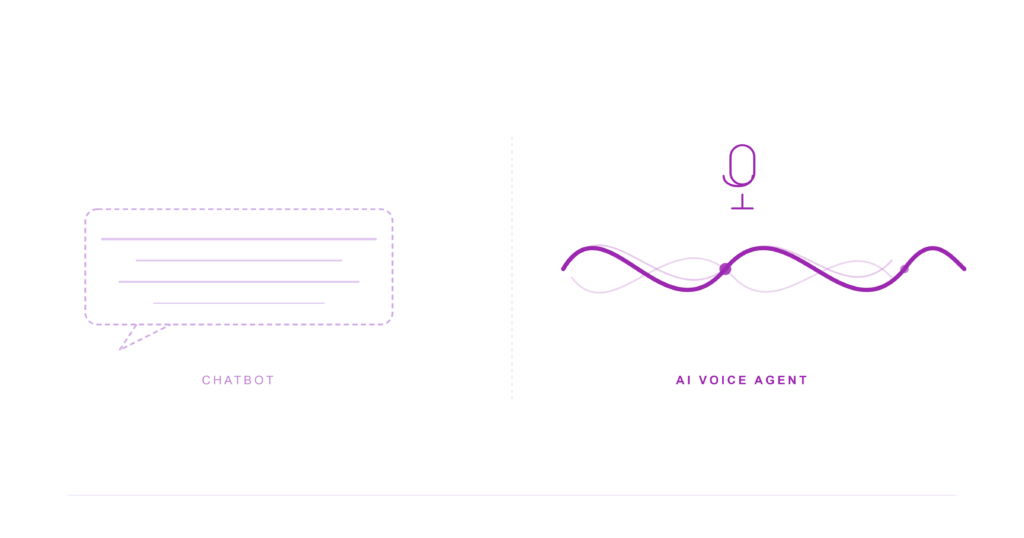
If you run a business today, you have probably heard the words “chatbot” and “AI voice agent” used almost interchangeably. But they are two very different technologies, and choosing the wrong one can cost you customers, money, and time.
This article will walk you through exactly what separates a traditional chatbot from a modern AI voice agent, why it matters for businesses in Saudi Arabia and across the Arab world, and how to decide which solution fits your needs. You will also learn why Arabic-speaking voice AI is no longer a futuristic idea but a practical reality businesses are deploying right now.
What Is a Chatbot?
A chatbot is a software program that communicates with people through written text. When you visit a website and a chat window pops up in the corner asking, “How can I help you today?” that is usually a chatbot at work.
Chatbots can range from very simple to fairly advanced. Early chatbots worked on fixed rules, they recognized specific keywords and replied with pre-written answers. If you typed something outside their script, they failed. Modern chatbots powered by large language models are much more flexible. They can understand context, answer follow-up questions, and handle a wider range of topics.
But at their core, chatbots are still text-first tools. They live on websites, mobile apps, WhatsApp, and other messaging platforms. The customer types something; the bot reads it and types back.
What Chatbots Do Well
- Answering frequently asked questions around the clock
- Handling order tracking and shipping status updates
- Collecting lead information like names, email addresses, and phone numbers
- Guiding users through simple self-service tasks, such as password resets
- Running surveys or post-purchase feedback forms
Where Chatbots Fall Short
A chatbot is designed for typed conversations on a screen. The moment a customer is frustrated, in a hurry, or dealing with a complex multi-step problem, typing back and forth becomes slow and unsatisfying. Chatbots also cannot detect the emotion or urgency in a person’s voice. They cannot hear that a customer is panicked or confused. They respond to words, not to how those words are delivered.
Research from Zendesk found that customers who have to repeat themselves to a different support agent are far more likely to switch to a competitor. A chatbot that fails to resolve a problem and then hands the customer off to a human agent creates exactly this friction.
What Is an AI Voice Agent?
An AI voice agent is a software system that communicates with people through spoken conversation. Instead of typing, the customer speaks. Instead of reading text, they hear a response. The entire interaction happens through voice, in real time.
This is fundamentally different from the old-style phone menu systems you may remember, the ones that said “Press 1 for billing, press 2 for technical support.” Those systems forced callers into rigid decision trees. If their problem did not fit any of the numbered options, they were stuck.
A modern AI voice agent is completely different. It listens to what you say in natural language, understands what you mean, connects to your business systems to find relevant information, and responds with a natural-sounding voice. The conversation flows like a real phone call with a knowledgeable human agent.
The Technology That Powers AI Voice Agents
Four core technologies work together inside an AI voice agent:
- Automatic Speech Recognition (ASR): Converts the customer’s spoken words into text in real time, handling different accents, dialects, and background noise with high accuracy.
- Natural Language Understanding (NLU): Analyzes the text to determine what the customer actually wants, their intent, and the key details they mentioned, such as an order number or a date.
- Large Language Models (LLM): Processes the understood intent, retrieves information from connected systems such as your CRM or inventory database, and generates the right response.
- Text-to-Speech (TTS): Converts the generated response back into natural-sounding speech so the customer hears a clear, human-like voice rather than a robotic monotone.
This entire cycle happens in less than two seconds, which is what makes the conversation feel natural rather than awkward.
| Key insight: AI voice agents do not just talk. They listen, understand, act, and respond, all in real time without human supervision. They can book appointments, update account details, process payments, and escalate to a human agent when needed, all within a single phone call. |
Chatbot vs. AI Voice Agent: A Side-by-Side Comparison
Here is a clear breakdown of how the two technologies differ across the factors that matter most to businesses:
| Feature | Traditional Chatbot | AI Voice Agent |
|---|---|---|
| Communication Mode | Text-based (chat) | Voice-based (spoken) |
| Technology Stack | NLP, LLM, intent detection | ASR + NLU + TTS + LLM |
| Response Speed | Asynchronous (2-5 sec OK) | Real-time (under 2 seconds) |
| Interaction Feel | Screen-based, visual | Natural conversation, hands-free |
| Emotional Intelligence | Limited | Detects tone, sentiment, urgency |
| Best Channel | Website, WhatsApp, app chat | Phone calls, voice platforms |
| Self-service Resolution | ~32% of queries | ~73% of queries |
| Handle Time | Multi-step, user-paced | Under 90 seconds per call |
| Cost Per Interaction | Lower at scale | Higher, but greater ROI on calls |
| Ideal For | FAQs, lead forms, order tracking | Complex queries, urgent support |
| Arabic/Dialect Support | Text NLP, limited dialects | Voice + dialect recognition |
| Accessibility | Requires typing | Hands-free, suits all abilities |
The numbers above come from real deployments. Voice AI agents achieve around 73% self-service resolution compared to approximately 32% for chatbots. Average handle time on voice AI drops to under 90 seconds per call, down from 4 to 7 minutes on traditional systems. These are not small gains; they change the economics of customer service.
How They Are Different in Daily Business Life
The best way to understand the difference is through real situations businesses face every day.
Situation A: A Customer Wants to Check an Order Status
Both a chatbot and a voice agent can handle this. The customer types or says their order number, and the system retrieves the status. For this kind of simple, structured task, a chatbot is perfectly sufficient and cheaper to run at scale.
Situation B: A Customer Has a Billing Dispute
The customer is upset. They have been charged twice and need a refund. They are speaking quickly. A chatbot asks them to type out the details, but they miss a step, the chatbot does not understand, and the conversation falls apart. The customer calls the phone line anyway.
An AI voice agent handles this differently. It hears the frustration in the customer’s voice. It detects urgency through vocal tone analysis. It pulls up the account, confirms the double charge, processes the refund, and sends a confirmation, all in one conversation. The customer hangs up satisfied.
Situation C: A Senior Citizen Needs Help Booking a Medical Appointment
Many people, particularly older adults, are not comfortable typing on a small phone screen. They are used to calling. A chatbot is not helpful here because the customer cannot or prefers not to type.
An AI voice agent serves this customer naturally. They call a number, speak in their native dialect, and the agent books the appointment, sends a reminder, and thanks them. No screen, no typing, no barrier.
| 73% of Voice AI self-service resolution vs. 32% for chatbots. Average handle time drops from 4-7 minutes to under 90 seconds. (Source: Industry data, 2025-2026) |
The Technology Gap: Why Voice Is Harder to Build
Building a chatbot is relatively straightforward today. Many no-code platforms let businesses set one up in a few hours. The inputs are clean, text is predictable, and typos are manageable.
Building a great AI voice agent is much harder. The system must handle real-world speech, which includes background noise, different accents, sentence fragments, filler words, and overlapping speech. It must respond within one to two seconds because longer delays feel unnatural on a phone call. It must understand dialects and local expressions, not just formal written language.
This is why the quality gap between voice AI systems is much wider than the quality gap between chatbot platforms. A poorly built chatbot is annoying. A poorly built voice agent sounds broken and damages your brand.
Building excellent Arabic voice AI is especially challenging because Arabic has multiple dialects that differ significantly from one region to another. What a caller says in Riyadh sounds different from what a caller says in Cairo or Beirut. A voice agent built for the Saudi market must understand the specific patterns, vocabulary, and pronunciation of Saudi Arabic dialects, not just Modern Standard Arabic.
When Should You Choose a Chatbot?
A chatbot is the right choice when:
- Your primary customer contact happens on your website, mobile app, or WhatsApp
- Most of your customer questions are simple, repetitive, and predictable
- Your customers are comfortable with typing on digital platforms
- You want to automate FAQ responses and basic lead capture at low cost
- Your customers interact in quiet environments where typing is natural
- You want to run surveys, collect structured data, or guide users through forms
Chatbots deliver strong return on investment for businesses where most support volume is low-stakes and text-native. E-commerce businesses handling thousands of order tracking requests per day, for example, find chatbots cost-effective and reliable for that specific task.
When Should You Choose an AI Voice Agent?
An AI voice agent is the right choice when:
- Most of your customer contacts arrive by phone
- Your customers value personal, conversational service
- You serve customers who are less comfortable with typing or small screens
- Your support involves complex, multi-step issues that need real-time guidance
- Customer satisfaction and first-call resolution directly affect your revenue
- You operate in healthcare, banking, real estate, hospitality, or other relationship-driven industries
- You need 24/7 availability without the cost of a full human call center
- Your customers speak Arabic dialects and expect culturally appropriate interactions
Industries seeing the strongest results with AI voice agents include healthcare (appointment scheduling, prescription reminders, patient follow-ups), banking and finance (account inquiries, fraud alerts, loan applications), real estate (property inquiries, viewing bookings), and government services (citizen assistance, visa applications, permit inquiries).
| The best approach for most businesses is not a choice between chatbot or voice agent. It is using both together. Chatbots handle high-volume, text-native queries. Voice agents handle calls, complex issues, and customers who prefer speaking. This hybrid model gives businesses the coverage and quality that neither tool delivers alone. |
The Saudi Arabia and Arab World Context
Saudi Arabia is one of the most exciting markets in the world for conversational AI right now. The conversational AI market in the Kingdom reached USD 158.8 million in 2025 and is projected to grow to over USD 1.6 billion by 2034, a compound annual growth rate of nearly 30%. The AI-powered chatbots market alone reached USD 249.6 million in 2025.
This growth is driven by Vision 2030’s digital transformation agenda, a young and highly connected population, rapid adoption of smartphones and smart devices, and serious government investment in Arabic language AI infrastructure.
The Arabic Language Challenge
One of the biggest barriers to AI adoption in the Arab world has historically been the Arabic language itself. Arabic is one of the most complex languages in the world for AI systems. It has rich grammatical structure, multiple dialects across 22 countries, a right-to-left script, and vocabulary that changes meaning based on context and diacritics.
For a long time, most commercial AI voice systems were built primarily for English. Arabic was an afterthought, often handled through rough translations that missed cultural nuance, dropped important context, or simply could not handle the dialect a Saudi customer was speaking.
That is changing rapidly. The Saudi government launched HUMAIN Chat in August 2025, the world’s first Arabic conversational AI powered by the ALLAM large language model, developed by a Public Investment Fund company. It supports multiple Arabic dialects and is built around Islamic values and cultural authenticity. Saudi-based Maqsam launched the first AI-powered Arabic phone bot in the MENA region in early 2025. Companies like Unifonic are building integrated Arabic conversational AI platforms connecting social listening, voice, and customer engagement.
For businesses in Saudi Arabia and the Gulf Cooperation Council region, this means the infrastructure for world-class Arabic AI voice agents now exists. The question is no longer whether it is possible to serve Saudi customers well through AI voice. The question is which platform does it best.
| Saudi Arabia Conversational AI Market: USD 158.8M in 2025, projected to reach USD 1.66B by 2034 (CAGR 29.8%). (Source: IMARC Group, 2025) |
Introducing ehlan.ai: Arabic-First AI Voice Agent for Saudi Arabia
Building an AI voice agent that actually works for Saudi customers requires more than translating an English system into Arabic. It requires understanding how Saudis speak, what they expect from a service interaction, the cultural norms around politeness and directness, and the specific dialects and expressions used across different regions of the Kingdom.
This is exactly what ehlan.ai was built to do.
ehlan.ai is an Arabic-first AI voice agent platform designed specifically for Saudi Arabia and the broader Arab world. While most international AI voice platforms treat Arabic as a secondary language, ehlan.ai was built from the ground up with Arabic at its core.
What Makes ehlan.ai Different
- Native Arabic voice intelligence: ehlan.ai understands the Saudi dialect the way a local would, including the informal expressions, regional vocabulary, and natural speech patterns that Saudi customers use when they call a business.
- Cultural alignment: The system is built around the communication norms of the Arab world, including the warmth, respect, and formality that Saudi customers expect from a quality service interaction.
- Bilingual capability: Many Saudi customers naturally switch between Arabic and English in a single conversation. ehlan.ai handles this code-switching smoothly without losing context or quality.
- Industry-ready: From healthcare appointment scheduling and banking inquiries to hospitality, retail, and government services, ehlan.ai’s voice agents are trained for the specific workflows that Saudi businesses run.
- 24/7 availability: ehlan.ai works around the clock, ensuring no call goes unanswered, whether a customer calls at noon on a weekday or late on a Thursday night.
For businesses in Riyadh, Jeddah, Dammam, and across the Kingdom, ehlan.ai offers something no international platform can fully deliver: a voice agent that sounds like it belongs, because it was built here.
| If your business receives calls from Arabic-speaking customers and you want those callers to experience service that feels natural, respectful, and genuinely helpful, ehlan.ai is built for exactly that. It speaks your customers’ language, understands their culture, and represents your brand the way you would want it represented. |
The Hybrid Future: Using Both Together
The debate between chatbots and AI voice agents is not about declaring a winner. Most businesses that deploy AI for customer service are moving toward a hybrid model where both technologies work together, each handling the interactions they are best suited for.
A customer might start a conversation on WhatsApp with a chatbot for a simple question. If the issue becomes more complex, the system can offer a voice callback. An AI voice agent calls the customer, picks up the context from the chatbot conversation, and resolves the issue without the customer having to repeat themselves. That kind of seamless transition is where the real customer experience gains are.
The voice AI market globally is expected to triple between 2025 and 2030, reaching USD 34 billion. Venture capital invested USD 6.6 billion in voice AI companies in 2025 alone. These numbers reflect where enterprise technology is heading. Voice is not an alternative to digital; it is the next layer on top of it.
| The global voice AI market is expected to reach USD 34 billion by 2030, tripling from its 2025 size. (Industry projections, 2026) |
Common Questions Businesses Ask
Is an AI voice agent the same as a voicebot or IVR?
No. An IVR (Interactive Voice Response) is the old press-1-for-billing system. A voicebot is a basic system that can handle simple spoken commands. An AI voice agent is a sophisticated system that understands natural language, manages full conversations, connects to your business data, and resolves complex requests without a script.
Can an AI voice agent replace my human call center staff?
It depends on your call volume and query types. AI voice agents can handle a large portion of routine and semi-complex calls entirely on their own. This frees your human agents to focus on genuinely complex cases, escalations, and high-value customer relationships. Most businesses find that voice AI reduces the number of calls reaching human agents by 50% to 70%, which significantly lowers costs while improving the customer experience.
How does an AI voice agent handle Arabic dialects?
The quality of Arabic dialect handling varies significantly between platforms. International platforms built for English and then adapted for Arabic often struggle with regional dialects, cultural expressions, and code-switching between Arabic and English. Platforms like ehlan.ai that are built natively for the Saudi and Arab market handle dialects naturally because the training data and system design reflect how people in this region actually speak.
Is voice AI secure for sensitive customer information?
Yes, when built on proper infrastructure. Enterprise-grade voice AI platforms encrypt all voice data, store it in compliant data centers, and follow regulatory requirements including Saudi Arabia’s Personal Data Protection Law (PDPL). Any platform you choose should be transparent about its data governance and compliance posture.
What does it cost to deploy an AI voice agent?
The cost varies depending on the complexity of your workflows, the volume of calls you handle, and the platform you choose. Unlike hiring and training human agents, AI voice agents have no shift costs, no sick days, and no training ramp-up. The economics improve significantly at scale. Most businesses that deploy voice AI see measurable cost reduction within the first few months.
Conclusion
Chatbots and AI voice agents are both powerful tools, but they serve different purposes and serve them in fundamentally different ways.
A chatbot is a text-first tool best suited for structured, repetitive queries on digital channels. It is cost-effective, easy to deploy, and works well for businesses where most customer contact happens through messaging platforms.
An AI voice agent is a conversation-first tool that handles the full complexity, emotion, and speed of spoken human interaction. It serves customers who prefer to call, who deal with complex issues, or who simply communicate better by speaking than by typing. For businesses in Saudi Arabia, where phone calls remain a primary customer contact channel and where Arabic-speaking customers expect culturally authentic service, AI voice agents deliver an experience that chatbots simply cannot match.
The Saudi Arabia conversational AI market is growing fast. Arabic-first voice AI is no longer experimental; it is production-ready. Businesses that adopt it now gain a service quality advantage over competitors who are still relying on traditional chatbots or human-only call centers.
If your business is ready to offer your customers a voice experience that truly speaks their language, ehlan.ai is where that journey starts.

As a writer for the Ehlan.ai blog, Hassan connects marketing strategy with AI voice technology. He helps business leaders learn how to attract, engage, and win customers in a world where automation gives companies the edge. His articles come from real campaign experience, deep knowledge of the region, and a clear view of how AI is changing the way brands talk to customers.
When he is not writing, Hassan follows the latest news from Riyadh's fast growing AI and tech scene and shares the most useful insights with the Ehlan.ai community
- AI Voice Agents for Real Estate Lead Qualification - September 27, 2026
- LEAP 2026 Saudi Arabia Review: What Really Happened and What It Means for Your Business - September 10, 2026
- Ehlan.ai AI Voice Agents vs Human Receptionists: Cost Comparison in KSA - September 6, 2026