
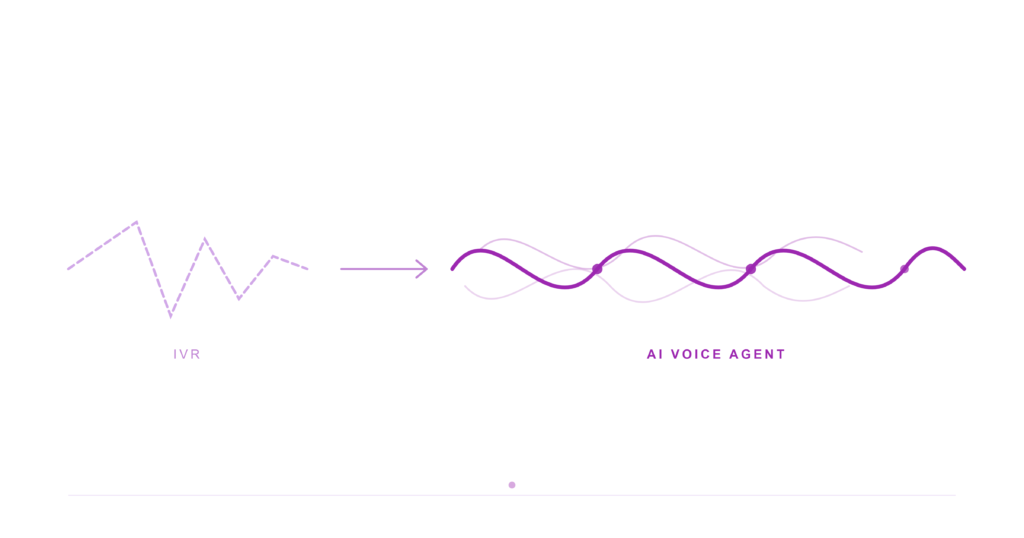
Think about the last time you called a company and heard: “Press 1 for Arabic, Press 2 for English, Press 3 for billing, Press 4 for support…”
How did that feel?
If your answer is frustrated, tired, or ignored — you are not alone. According to a Vonage Global Customer Engagement Report, over 60% of consumers say they dislike IVR menus, and many hang up rather than push through them. A separate study found that 51% of customers have completely abandoned a business after one too many frustrating phone menu experiences.
That is not a customer complaint. That is lost revenue.
For decades, Interactive Voice Response (IVR) systems served as the backbone of customer communication. They were built in the 1970s and 1980s to handle high call volumes without human operators. At the time, they were revolutionary. Today, they are a bottleneck.
Modern customers expect instant, natural, personalized conversations. They do not want to navigate five levels of a menu to ask a simple question. They do not want to repeat their account number three times to three different agents. And they do not want to be told to call back during business hours.
This is exactly why businesses around the world, and especially in Saudi Arabia and the GCC, are replacing IVR systems with AI voice agents.
This article explains what is driving this shift, what makes AI voice agents fundamentally different, and how businesses can make the transition in a way that reduces costs, improves customer satisfaction, and positions them ahead of the competition.
What Is an IVR System and Why Did Businesses Use It?
An Interactive Voice Response system is an automated phone technology that interacts with callers through pre-recorded audio menus. The caller listens to a set of options and responds by pressing a number on their keypad or saying a basic command like “yes” or “no.”
For example:
- “Press 1 for account balance”
- “Press 2 for technical support”
- “Press 3 to speak to an agent”
When IVR first appeared, it was a genuine innovation. A bank receiving 200,000 calls per day could not hire enough agents to handle every call manually. IVR solved that problem by automating simple routing. Businesses saved money on staffing, reduced queue times, and could operate at scale.
The economics made sense. A single IVR-handled interaction cost pennies compared to several dollars for a live agent. For simple queries like checking account balances or confirming store hours, IVR did its job.
But something changed. Customer queries grew more complex. Customer expectations grew higher. And IVR stayed exactly the same.
Why IVR Systems Are Failing Modern Businesses
The core problem with IVR is that it was designed around technology constraints, not around human behavior. It forces callers to adapt to the system. Real people do not think in numbered menu options. They describe problems in their own words, jump between topics, and reveal details naturally as the conversation flows.
IVR has no way to handle that.
Here is what happens in practice:
1. Customers Press Zero and Skip the System
Industry research consistently shows that zero-out rates in enterprise IVR systems range from 25% to 40%. For a contact center fielding 50,000 calls per day, that means up to 20,000 calls skip the entire automated system and go straight to a human agent queue. The IVR investment delivers almost no value for those callers.
2. Wrong Menu Selections Lead to Wrong Transfers
Because callers are forced to guess which option fits their issue, they frequently choose incorrectly. A customer with a billing question that involves a cancelled subscription might press 1 for sales because there is no dedicated billing-plus-cancellation option. The result is a transfer, another hold, another agent who asks for the account number again. This wastes time and damages customer trust.
3. Call Abandonment Rates Spike During Peak Periods
When hold times extend beyond three minutes, abandonment rates climb sharply. These are not minor operational metrics. They represent high-intent customers who wanted to buy something, resolve an issue, or book an appointment, and your phone system pushed them away. Many of those callers immediately contact a competitor.
4. Repeat Calls Indicate Unresolved Issues
Repeat call rates, defined as the same customer calling back within 48 hours, are a direct signal of IVR failure. When the system misroutes a caller or cannot resolve their issue, they call again. Each repeat call adds cost without adding value.
5. The Hidden Cost Is Enormous
The cost of IVR failure does not appear as a single line item on a report. It accumulates across abandonment, repeat calls, agent time spent on unnecessary transfers, and declining customer satisfaction scores. Research suggests that these hidden costs typically amount to 20 to 30% of a contact center’s total operational spend. The IVR was supposed to reduce costs. In many organizations, it now generates a significant portion of them.
6. Poor Experience Destroys Brand Reputation
According to NICE research, customer satisfaction (CSAT) scores for IVR-routed calls run 28 to 41 points lower than calls handled by AI or human agents. When your automated phone system actively frustrates customers, every interaction is a small erosion of brand trust.
What Is an AI Voice Agent?
An AI voice agent is a software system that can hold a real phone conversation using artificial intelligence. It understands natural spoken language, interprets what the caller actually means, and responds in a human-sounding voice, all in real time, without any menus or button presses.
The technology behind modern AI voice agents combines several advanced components:
Automatic Speech Recognition (ASR) converts the caller’s voice into text in real time. Modern ASR handles accents, background noise, and natural speech patterns far better than older speech recognition technologies.
Natural Language Understanding (NLU) analyzes the text to understand what the caller actually wants. This is the critical difference from IVR. A caller who says “I got charged twice for something I cancelled last month” is expressing a clear intent that IVR cannot parse. An AI voice agent powered by a large language model understands the intent instantly and proceeds to resolve it.
Large Language Models (LLMs) generate contextually appropriate responses based on the full conversation, not just the last sentence. The agent remembers what was said earlier in the call, adapts its tone, asks clarifying questions when needed, and delivers answers that feel natural.
Text-to-Speech (TTS) converts the AI’s response back into spoken audio. Modern TTS does not sound robotic. It produces natural, fluid, human-like speech that can be customized to match a brand’s voice and tone.
Backend Integrations allow the AI agent to actually do things during the call, not just answer questions. It can check a live calendar and book an appointment, look up an order status in a CRM, verify account details, process a payment, or create a support ticket, all while the conversation is happening.
The result is a caller experience that feels like talking to a knowledgeable, always-available, always-patient team member.
The Key Differences: IVR vs. AI Voice Agents
| Factor | IVR System | AI Voice Agent |
|---|---|---|
| Interaction Style | Menu-driven, button presses | Natural conversation, free speech |
| Language Understanding | Fixed commands only | Full sentence understanding with context |
| Call Resolution Rate | 20 to 40% of calls | 50 to 80% of calls resolved without human |
| Customer Experience | Frustrating, robotic | Natural, helpful, human-like |
| Availability | 24/7 (basic routing only) | 24/7 with full resolution capability |
| Scalability | Handles volume, not complexity | Handles both volume and complexity |
| Update Speed | Weeks to modify menu flows | Hours to update conversation logic |
| CRM Integration | Limited or none | Deep integration with live data access |
| Cost per Interaction | Low (routing only) | Very low (full resolution) |
| Multilingual Support | Pre-recorded options | Native language understanding |
The most important row in that table is call resolution rate. IVR routes calls. AI voice agents resolve them. That difference is the entire business case.
The Business Benefits of Switching to AI Voice Agents
Dramatic Cost Reduction
AI voice costs roughly $0.40 per call on modern platforms, compared to $7 to $12 per call with human agents. That represents a 90 to 95% reduction in per-call cost for interactions the AI handles independently.
AI voice agents resolve 60 to 80% of calls without any human involvement. The calls that do reach a human agent are the ones that genuinely require a person. When Forrester tracked three-year ROI for companies that replaced IVR with conversational AI, they documented returns of 331% to 391%. Most mid-market businesses see measurable ROI within two to six months after deployment.
24/7 Coverage Without Staffing Costs
A human receptionist or agent can only work a certain number of hours. AI voice agents work every hour of every day, including weekends, holidays, and the busy periods when your team is overwhelmed. Every missed call is a missed opportunity. Businesses that deployed AI voice agents report capturing significant revenue from after-hours inquiries that would previously have gone to voicemail and never been returned.
Higher Customer Satisfaction
AI voice agents deliver better customer experiences because they start from the caller’s perspective, not the system’s. They eliminate hold music, menu confusion, and the frustration of repeating information. Callers state what they need in plain language and get an immediate, helpful response.
A dental practice that replaced their IVR with an AI voice agent saw a 34% increase in bookings from after-hours calls within the first month. Calls that would have gone to voicemail were being handled immediately and appointments were booked directly.
Better First-Call Resolution
Because AI voice agents understand intent, access live data, and can actually take action during the call, they resolve issues on the first contact far more often than IVR. First-call resolution is the single metric most directly tied to customer satisfaction and long-term loyalty. AI outperforms IVR on this metric by three to five times in well-documented enterprise deployments.
Scalability Without Headcount
When call volume spikes during a campaign, a product launch, or a seasonal rush, IVR routes the overflow to queues that are already full. AI voice agents handle thousands of simultaneous conversations without any increase in cost per call. Growth no longer requires proportional growth in support staff.
Actionable Data and Insights
Every conversation an AI voice agent handles is transcribed, analyzed, and stored. Businesses gain a clear picture of what customers are actually asking about, what problems are most common, what language they use, and where satisfaction breaks down. This intelligence is far more valuable than the call routing logs that IVR produces.
Industries Leading the Transition
Healthcare and Medical Clinics
Medical practices field extremely high volumes of repetitive calls: appointment scheduling, prescription refill requests, insurance verification, and general inquiries. All of these are fully automatable. A 2025 patient access survey found that 66% of patients report difficulty reaching their provider, and many switch practices rather than calling back. AI voice agents solve this directly by answering every call, booking appointments from live calendar data, and providing accurate information around the clock.
Banking and Financial Services
Banks and insurance companies use AI voice agents for balance inquiries, fraud alert notifications, loan status updates, payment processing, and collections. The improvement in first-call resolution in this sector is particularly significant because complex financial queries rarely fit neatly into IVR menus.
Retail and E-commerce
Order tracking, return processing, product questions, and delivery updates are high-volume, repetitive tasks that AI voice agents handle naturally. Retailers deploying AI voice agents report significant reductions in agent workload and improvements in post-purchase customer satisfaction.
Telecommunications
Billing questions, outage reporting, technical troubleshooting, and account management make telecommunications one of the highest-volume call environments. High call volumes combined with high agent costs make AI voice agents the clearest economic choice in this sector.
Real Estate and Property Management
Scheduling property viewings, answering listing inquiries, qualifying leads, and following up with prospective buyers are tasks that require immediate response but do not need a senior agent. AI voice agents handle the full qualification workflow and ensure no lead goes unanswered.
Government and Public Services
Government agencies in the GCC are deploying AI voice agents to handle citizen inquiries, appointment scheduling, and service navigation. This aligns directly with the digital transformation mandates that define Vision 2030 in Saudi Arabia.
The Saudi Arabia Opportunity: Why This Matters Now for GCC Businesses
Saudi Arabia is at a unique inflection point. Vision 2030 has positioned digital transformation as a national priority, with 66 of the 96 key goals tied to data and AI adoption. The Saudi conversational AI market reached USD 158.8 million in 2025 and is projected to grow to USD 1.66 billion by 2034, a compound annual growth rate of nearly 30%.
AI investment in Saudi Arabia is projected to reach USD 1.9 billion by 2027 and is expected to contribute USD 135 billion to GDP by 2030. The infrastructure is already being built. Zain KSA launched its 5G Standalone network in 2025, providing the low-latency connectivity that real-time voice AI requires.
But the most important factor for GCC businesses is a simple truth: the Arabic-speaking customer deserves a great experience in their own language.
For years, international AI platforms have offered Arabic as an afterthought. They provide translated interfaces that miss the linguistic complexity, the regional dialects, and the cultural nuances that Arabic speakers expect. Gulf Arabic is fundamentally different from Modern Standard Arabic and from Egyptian or Levantine dialects. A customer calling from Riyadh speaks differently from a customer in Jeddah or Dammam. Generic global platforms do not handle that variation well.
This is why Arabic-native AI voice solutions built specifically for the Saudi market are seeing rapid adoption. Businesses that deploy AI voice agents trained on real Saudi Arabic conversations, calibrated to local dialects and cultural context, deliver experiences that feel genuinely respectful and natural to their customers.
Introducing Ehlan.ai: The AI Voice Agent Built for Saudi Arabia
If you are running a business in Saudi Arabia and still relying on an IVR system, or on a human receptionist handling repetitive calls, you are paying more than you need to and missing opportunities you cannot afford to miss.
Ehlan.ai is an AI voice agent platform built specifically for the Saudi market. It understands Saudi Arabic dialect naturally, responds in seconds, and handles your customer calls 24 hours a day, seven days a week, across calls, WhatsApp, and SMS.
Here is what makes Ehlan.ai different from generic international platforms:
Saudi Dialect Understanding from the First Word. Ehlan.ai is trained on real Saudi Arabic conversations. It does not translate. It understands. Customers in Riyadh, Jeddah, and Dammam speak naturally, and Ehlan.ai keeps up without misunderstandings or awkward pauses.
Goes Live in Hours, Not Months. Many businesses assume switching to AI voice requires a long, expensive IT project. Ehlan.ai connects to your existing phone line and tools without any rewriting of infrastructure. Setup is complete in hours, and your AI agent is live taking calls the same day.
No Missed Calls, No Missed Revenue. Whether it is 2 AM on a Friday or peak hour on a Tuesday, Ehlan.ai answers every call instantly. A clinic in Riyadh that implemented Ehlan.ai reported that the system answers calls in Saudi dialect naturally, books appointments automatically, and never misses a lead, even after hours.
Handles the Routine So Your Team Can Focus. Ehlan.ai manages around 70% of routine inquiries across calls and WhatsApp, including lead qualification, appointment booking, order status, and general support. Your team is freed to handle the conversations that genuinely need a human.
Real Cost Savings. Businesses using Ehlan.ai typically cut customer service costs by 40 to 70%. When you compare the true total cost of a human receptionist, including salary, housing allowance, transport, iqama costs, and overtime, against the monthly cost of an AI agent that works every hour without breaks, the math is simple.
Bilingual by Default. Saudi businesses serve both Arabic and English-speaking customers. Ehlan.ai switches naturally between Arabic and English within a single conversation, matching the caller’s preferred language without any manual configuration.
For any business in Saudi Arabia that handles customer calls, Ehlan.ai is worth a conversation. You can experience a live demo in Saudi Arabic at ehlan.ai and see exactly how the system handles your real-world customer scenarios.
How to Make the Transition: A Practical Approach
Switching from IVR to AI does not require ripping out everything you have built. Most enterprises start with a phased approach that reduces risk and lets you measure ROI before committing fully.
Phase 1: Audit Your Current Call Flows
Start by understanding what your IVR is actually handling, and more importantly, what it is failing to handle. Pull your abandonment rates, your zero-out rates, and your transfer rates. Identify the top five call types by volume. These are your highest-value automation targets.
Phase 2: Start with High-Volume, High-Impact Use Cases
Do not try to automate everything at once. Begin with the call types that are both high volume and repeatable, such as appointment scheduling, order status inquiries, business hours, or simple account questions. Deploy your AI voice agent on these call flows first.
Phase 3: Run in Parallel and Measure
Keep your IVR handling general routing while the AI agent takes over specific call types. Track first-call resolution, abandonment rates, and customer satisfaction scores side by side. The data will show you the value being delivered and guide your next expansion.
Phase 4: Expand and Optimize
As the AI agent proves itself on initial use cases, expand its scope. Move more complex call types to the AI. Integrate it more deeply with your CRM, your booking system, and your support ticketing platform. Use the conversation data to continuously improve responses and identify new automation opportunities.
Phase 5: Retire Legacy Flows
Over time, legacy IVR automations are deprecated as agentic AI flows replace them. The transition becomes organic rather than disruptive.
Common Questions Businesses Ask Before Switching
Will customers know they are talking to an AI?
Modern AI voice agents are transparent about what they are when asked. Most businesses configure their agents to introduce themselves as an AI assistant. The key is that the experience is good enough that customers do not mind. A fast, helpful, accurate AI response is far preferable to a slow, frustrating IVR menu or a long hold time.
What happens when the AI cannot handle a call?
AI voice agents are configured with smart escalation logic. When a caller’s request falls outside the agent’s capability, or when the caller expresses frustration, the system transfers the call to a human agent with full context, including a summary of what was already discussed. The human does not need to ask for the account number again.
Is it secure and compliant?
Enterprise AI voice platforms are designed with security as a core requirement, not an afterthought. In Saudi Arabia and the GCC, businesses need to confirm that their chosen platform complies with Saudi Arabia’s Personal Data Protection Law (PDPL) and stores data in compliance with local data residency requirements. Ehlan.ai operates specifically for the Saudi market with these requirements built into its architecture.
How long does implementation take?
This depends on the complexity of the deployment, but most businesses can go from decision to live calls in days rather than months. Platforms designed for ease of deployment, like Ehlan.ai, can have your AI agent live in hours.
What about calls in multiple Arabic dialects?
This is precisely where Arabic-native platforms outperform international generic tools. An AI voice agent built on real Saudi Arabic data, not translated from English or trained on Modern Standard Arabic alone, handles the natural variation in speech that real customers bring to every call.
The Competitive Reality: What Happens If You Wait
Gartner forecasts that conversational AI will reduce contact center labor costs by $80 billion globally in 2026 alone. The businesses driving that saving are not planning to share it with the ones that are still operating on 1980s phone technology.
Over 70% of contact centers increased their AI spending in 2023 and 2024. That number has continued to grow. The businesses making that investment are not chasing trends. They are responding to a simple reality: customers have higher expectations than ever, and the cost of failing to meet those expectations is measured in lost revenue and lost loyalty.
In Saudi Arabia specifically, the competitive dynamics are accelerating. Vision 2030 is creating an environment where government services, banks, hospitals, retailers, and real estate companies are all moving toward AI-powered customer interaction. Businesses that adopt early will set a standard that competitors have to chase. Businesses that wait will find themselves explaining to customers why their experience is so much worse than what they get elsewhere.
The question for every business leader is not whether to make the shift. That decision is already being made industry-wide. The question is whether to be ahead of it or behind it.
Conclusion
Your phone line is the front door to your business. Every call that goes unanswered is a customer who walked away. Every frustrating menu interaction is a small step toward losing that customer permanently. Every call that gets misrouted wastes your team’s time and your customer’s patience.
AI voice agents change what that front door experience looks like. They answer every call instantly. They speak your customer’s language, literally, in the right dialect, with the right cultural tone. They resolve issues on the first contact, book appointments while the caller is still on the line, and hand off to your team only when a human is genuinely needed.
For businesses in Saudi Arabia, the path forward is even clearer. The market is growing rapidly, the technology is available, Vision 2030 is creating conditions for accelerated adoption, and the customers are ready for a better experience.
If you are still running an IVR system, the only remaining question is how quickly you can replace it with something that actually serves your customers.
Ehlan.ai was built exactly for this moment, for Saudi businesses that want to move fast, serve customers in authentic Saudi Arabic, and do it without a complicated, months-long IT project. You can learn more and hear the agent in action at ehlan.ai.
The era of “Press 1 for Arabic” is over. The era of actually speaking your customer’s language, 24 hours a day, is here.

As a writer for the Ehlan.ai blog, Hassan connects marketing strategy with AI voice technology. He helps business leaders learn how to attract, engage, and win customers in a world where automation gives companies the edge. His articles come from real campaign experience, deep knowledge of the region, and a clear view of how AI is changing the way brands talk to customers.
When he is not writing, Hassan follows the latest news from Riyadh's fast growing AI and tech scene and shares the most useful insights with the Ehlan.ai community
- AI Voice Agents for Real Estate Lead Qualification - September 27, 2026
- LEAP 2026 Saudi Arabia Review: What Really Happened and What It Means for Your Business - September 10, 2026
- Ehlan.ai AI Voice Agents vs Human Receptionists: Cost Comparison in KSA - September 6, 2026