
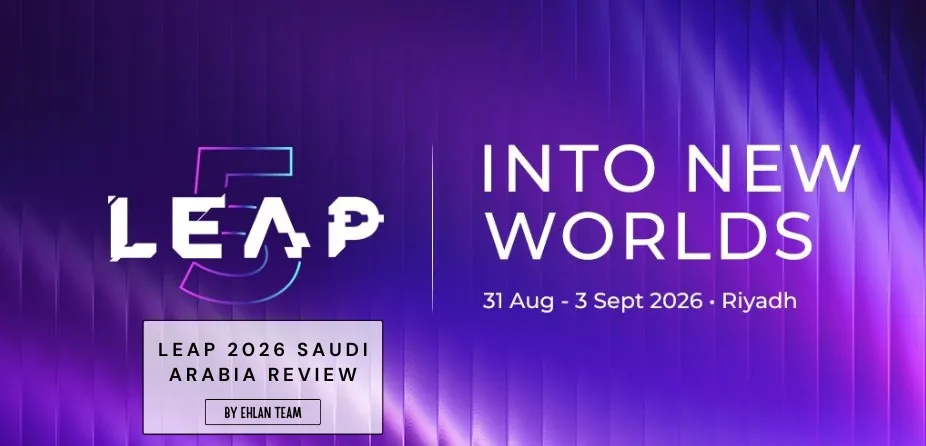
LEAP 2026 closed its doors in Riyadh with more than 200,000 visitors, over $15 billion in investments announced on day one alone, and a guest list that included AWS, Microsoft, AMD, Cisco, Aramco, and Saudi Arabia’s own AI company, HUMAIN. If you only read the headlines, it looks like a straightforward success story. The real picture is more interesting.
This review covers what actually happened at LEAP 2026, why the event almost did not happen on schedule, which announcements matter beyond the press releases, and what any of this means if you run a business in Saudi Arabia rather than a technology conglomerate. No jargon, no inflated claims, just a clear walkthrough of the fifth edition of the Kingdom’s flagship tech event.
What Is LEAP 2026? A Quick Overview
LEAP is Saudi Arabia’s flagship technology and innovation conference, held annually in Riyadh since 2022. It is organized by the Ministry of Communications and Information Technology (MCIT), the Saudi Federation for Cybersecurity, Programming, and Drones (SAFCSP), and Tahaluf, a joint venture with Informa PLC. It is widely described as the world’s most attended technology event by in-person visitor numbers.
| Detail | Information |
|---|---|
| Edition | 5th edition |
| Theme | “Into New Worlds” |
| Dates | August 31 to September 3, 2026 |
| Venue | Riyadh Exhibition and Convention Center (RECC), Malham, Riyadh |
| Visitors | 200,000+ |
| Startups | 600+ |
| Speakers | 1,000+ |
| Global tech brands | 1,800+ |
| Investors | 1,900+, managing roughly $18 trillion in combined assets |
| Investments announced | Over $15 billion on opening day, plus additional deals across the remaining three days |
| Organizers | MCIT, SAFCSP, Tahaluf (Informa PLC) |
LEAP’s program spans artificial intelligence, cloud and data infrastructure, cybersecurity, fintech, health technology, smart cities, robotics, quantum computing, digital health, gaming, sports technology, and space. DeepFest, a co-located event focused entirely on the global AI community, ran alongside the main show.
The Story Behind the Dates: Why LEAP 2026 Almost Did Not Happen in Its Usual Slot
Here is something most coverage glosses over. LEAP 2026 was not originally scheduled for late August. It was set to run April 13 to 16, 2026, in its usual early-year slot.
In March 2026, organizers postponed the event to August 31 to September 3, citing consultations with partners and stakeholders to ensure strong international participation. The real driver was regional instability tied to the conflict between the US, Israel, and Iran, which disrupted flights, travel advisories, and event planning across the Middle East during that period. Several other major regional events, including the Arabian Travel Market, faced similar delays.
The rescheduling was not a small operational tweak. It meant running Saudi Arabia’s biggest annual tech event in late summer, with Riyadh temperatures regularly above 40 degrees Celsius, instead of the cooler February to April window LEAP had used in every previous edition. It also compressed the runway organizers had to lock in speakers, sponsors, and exhibitors.
Despite that, LEAP 2026 still delivered its highest opening-day investment figure to date and matched its usual scale in visitor numbers. That resilience is arguably the most underreported story of this year’s event, and it says something about how much momentum LEAP has built since 2022.
The Numbers That Matter: Investment and Growth
LEAP has grown every year since launch, both in attendance and in the size of deals announced on site.
- 2022 (inaugural edition): 100,000+ visitors, $6.4 billion in announced investment
- 2023: 172,000+ visitors, 900+ exhibitors, $9 billion in announced investment
- 2024: 215,000+ visitors, $13.4 billion in announced investment, $11.9 billion of it on opening day
- 2025: 201,000+ visitors, 1,800+ exhibitors, $14.9 billion in AI-focused investment commitments
- 2026: 200,000+ visitors, over $15 billion on opening day alone, roughly $2.5 billion more on day two, and around $857 million on day three
Across its first five editions, LEAP has generated more than $42 billion in cumulative announced technology investment. Independent analysis commissioned by the organizer also attributes close to $1.9 billion in broader economic impact to the event between 2022 and 2025, covering visitor spend and business activity in Riyadh.
Alongside the conference itself, Saudi Arabia’s Minister of Communications and Information Technology, Abdullah Alswaha, noted that the Kingdom’s digital economy has grown 69 percent since LEAP launched, from $118 billion to $199 billion, while women now make up 36 percent of the technology workforce. LEAP has effectively become a yearly scoreboard for Saudi Arabia’s Vision 2030 technology goals, not just a trade show.
The Big Announcements at LEAP 2026
AI Infrastructure and Cloud Computing
Most of the largest deals at LEAP 2026 were about physical infrastructure rather than consumer products.
- AWS confirmed its first cloud infrastructure region in Saudi Arabia remains on track to open in December 2026, backed by more than $5.3 billion in planned investment. AWS also deepened its partnership with HUMAIN to make up to 50MW of AI compute capacity available through Saudi Arabia’s first dedicated AI Zone by 2028.
- Microsoft announced its new Saudi Arabia East cloud data center region, with three availability zones, becoming available to customers in November 2026.
- AMD, Cisco, and HUMAIN confirmed their first AMD Instinct GPU-based AI infrastructure had gone live in the Kingdom, with plans to add up to 250 megawatts of additional AI computing capacity.
- HUMAIN and DataVolt expanded a joint project to build a 360-megawatt AI-ready data center at Oxagon, part of NEOM on the Red Sea coast.
HUMAIN’s Big Moment
HUMAIN, the AI company owned by Saudi Arabia’s Public Investment Fund (PIF), was the single most active participant at LEAP 2026.
- HUMAIN M3, a new open-weights Arabic language model trained on more than one trillion Arabic tokens
- HUMAIN Voice, a conversational AI platform built to handle multiple Arabic dialects, including Saudi, Egyptian, Levantine, and Maghrebi Arabic
- HUMAIN AI PC, a personal computer running both Windows and HUMAIN’s AI features, aimed at enterprise customers from September 20, 2026, with a target of one million units sold across the Middle East and Africa by 2030
- A strategic partnership with Applied Intuition to build autonomous trucking across Saudi logistics corridors, targeting thousands of driverless trucks on the road by 2030
- A $5 billion joint investment between HUMAIN and AWS to build the AWS-HUMAIN AI Zone
The Real Trend Underneath the Headlines: Arabic AI Is Going Mainstream
Strip away the billion-dollar figures, and one theme runs through almost every major LEAP 2026 announcement: Arabic-language AI, especially spoken Arabic, has become a serious business category rather than a research curiosity.
HUMAIN’s headline launches were both language models, and Adobe announced it is developing an image-generation model with HUMAIN designed around Saudi culture and capable of understanding Arabic-language prompts. The reason this matters commercially is dialect. Modern Standard Arabic, the formal version used in news and official documents, is not how people actually speak on the phone. Saudi Arabic alone splits into distinct regional varieties, including Najdi around Riyadh, Hijazi near Jeddah and Makkah, and Eastern Gulf speech around Dammam. A system that only understands formal Arabic will misfire constantly on a real customer call.
This is exactly the gap that HUMAIN Voice is aimed at solving at a national infrastructure level, and it is also the problem that dialect-focused voice AI companies have already been solving at the business level for the past couple of years. Ehlan.ai, for example, is an Arabic-first AI voice agent built specifically for Saudi and wider Gulf dialects rather than generic Modern Standard Arabic. Businesses such as clinics and service companies in Riyadh already use it to answer incoming calls, book appointments, and follow up on leads in natural Saudi dialect, around the clock, without a customer noticing they are talking to an AI system. It is a useful, concrete example of where LEAP’s big AI announcements eventually land: not in a keynote, but in a phone call your customer makes to your business next week.
Quantum Computing and Cybersecurity
Saudi Arabia’s King Abdulaziz City for Science and Technology (KACST), through its National Center for Quantum Technologies, signed a research collaboration agreement with a French quantum computing partner. Cybersecurity also featured prominently across the agenda, reflecting how central it has become to Saudi Arabia’s broader digital infrastructure push, alongside the cloud and AI investments listed above.
Physical AI, Manufacturing, and Localization
Beyond software, LEAP 2026 leaned hard into physical technology and local manufacturing.
- Lenovo unveiled its first laptop manufactured in Saudi Arabia, with limited production expected to start later in 2026
- HPE expanded its Saudi localization program
- Nokia announced plans for its first research and development center in the Kingdom
- Alfanar committed $150 million to manufacture data center components locally
- The agenda also featured autonomous vehicle demonstrations, robotaxis, and flying-taxi displays, alongside the more consequential infrastructure deals
Beyond Tech: Tourism, Energy, and Industry
The Saudi Ministry of Tourism signed an agreement with Accenture Saudi Arabia to explore how AI can support tourism development. Saudi Aramco and Aramco Digital announced agreements covering cybersecurity, industrial AI, and technology localization, a sign that AI investment at LEAP is no longer limited to consumer and enterprise software.
What LEAP 2026 Means If You Run a Business in Saudi Arabia
Most of the headline numbers from LEAP 2026 involve billion-dollar infrastructure deals that will not directly touch a small or mid-sized business for years. But a few practical takeaways apply right now, regardless of your company’s size.
Arabic-first AI tools are no longer experimental. With HUMAIN pushing a national Arabic voice and language model, and businesses already deploying dialect-aware AI voice agents for customer calls, WhatsApp, and appointment booking, this is one of the few LEAP 2026 trends an ordinary business can adopt this quarter, not in 2030. Clinics, real estate agencies, and retail businesses are already using tools such as Ehlan.ai to handle missed calls and after-hours inquiries in natural Saudi Arabic, which is a direct, practical extension of what HUMAIN previewed on the main stage.
Cloud capacity is about to expand sharply. With AWS launching in December 2026 and Microsoft’s new Eastern Region live from November 2026, Saudi businesses will soon have more local data center options, which matters for data residency and compliance under Saudi Arabia’s Personal Data Protection Law (PDPL).
Talent, not hardware, is the harder problem. Several analysts covering LEAP 2026 pointed out that Saudi Arabia can buy GPUs and build data centers faster than it can build a workforce that knows how to train, secure, and deploy AI systems. If you are hiring or upskilling a team, this is where the actual bottleneck sits.
What LEAP 2026 Means for Startups and Investors
LEAP’s Rocket Fuel competition awarded $1 million across seven startup prizes during its closing days. More than 600 startups exhibited, and the event drew 1,900-plus investors managing a combined $18 trillion in assets, according to organizers.
For founders weighing whether LEAP is worth exhibiting at, one startup’s own recap of LEAP 2026 (Dadan, a Riyadh-based SaaS company) captured the value clearly: it was one of the only chances an internationally distributed team gets to meet its Saudi-based users face to face, and the in-person credibility of meeting real customers outweighed the effort of building and staffing a booth.
For investors and larger firms, it is also worth noting that Riyadh will host SuperReturn Saudi Arabia in January 2027, a private capital event organized in partnership with Jada Fund of Funds, which previously attracted more than 1,000 senior private capital professionals. For anyone raising capital in the region, that gathering is arguably as relevant as LEAP itself.
The Attendee Experience: Was LEAP 2026 Worth Attending?
What worked well
- The scale and density of decision-makers in one venue is genuinely hard to replicate at any other regional event
- Government-level backing meant real deals, not just announcements of intent
- DeepFest gave AI-focused attendees a more concentrated program within the wider event
- LEAP’s expansion into Hong Kong through LEAP East (its first edition ran in July 2026, drawing over 25,000 visitors) shows the event is scaling internationally, not just growing in Riyadh
What was harder
- The rescheduling to late August meant attendees dealt with serious summer heat in Riyadh, along with proximity to Hajj-season travel demand
- With 200,000-plus visitors across four days, queues, hall crowding, and session capacity were recurring complaints in visitor reviews
- Some coverage noted the agenda leaned toward spectacle (robots, robotaxis, flying-taxi demos) over hands-on technical workshops that would help close Saudi Arabia’s AI skills gap
- Full pass pricing applies once early bird phases end, and costs can add up quickly for a small team attending as a group
How LEAP Has Grown Since 2022
LEAP launched in February 2022 as a three-day event under the theme “One Eye on the Stars,” with roughly 700 companies and 100,000 visitors. Four editions later, it has become the world’s most attended in-person technology event by visitor count.
| Edition | Visitors | Investment Announced |
|---|---|---|
| 2022 | 100,000+ | $6.4 billion |
| 2023 | 172,000+ | $9 billion |
| 2024 | 215,000+ | $13.4 billion |
| 2025 | 201,000+ | $14.9 billion |
| 2026 | 200,000+ | $15 billion+ (opening day) |
That trajectory, alongside the fact that 2026 still delivered a record opening-day figure despite a forced three-and-a-half-month postponement, is the clearest evidence that LEAP has become structurally important to Saudi Arabia’s tech and investment calendar rather than a one-off marketing exercise.
Frequently Asked Questions About LEAP 2026
What is LEAP 2026? LEAP 2026 is the fifth edition of Saudi Arabia’s flagship technology and innovation conference, held in Riyadh under the theme “Into New Worlds.” It covers artificial intelligence, cloud computing, cybersecurity, fintech, smart cities, and more.
When and where did LEAP 2026 take place? LEAP 2026 ran from August 31 to September 3, 2026, at the Riyadh Exhibition and Convention Center in Malham, Riyadh. It was originally scheduled for April 13 to 16, 2026, but was postponed due to regional conflict-related disruptions.
How many people attended LEAP 2026? Organizers reported more than 200,000 visitors, alongside 600-plus startups, 1,000-plus speakers, 1,800-plus global technology brands, and 1,900-plus investors.
What were the biggest announcements at LEAP 2026? The largest announcements centered on AI infrastructure: AWS’s Saudi cloud region launching in December 2026, Microsoft’s Eastern Region launching in November 2026, HUMAIN’s new Arabic AI models and voice platform, and a strategic partnership between HUMAIN and Applied Intuition for autonomous trucking.
What is HUMAIN? HUMAIN is Saudi Arabia’s Public Investment Fund-owned AI company. At LEAP 2026, it launched HUMAIN M3, an Arabic language model, HUMAIN Voice, a multi-dialect Arabic conversational AI platform, and an AI-enabled personal computer.
Is LEAP 2026 only about AI? No. While AI dominated the headlines, the agenda also covered cloud infrastructure, cybersecurity, fintech, quantum computing, health technology, smart cities, gaming, and space technology.
How can Saudi businesses benefit from LEAP 2026’s AI announcements now, rather than years from now? The most immediately usable trend is Arabic-dialect voice AI. Tools such as Ehlan.ai already let Saudi businesses deploy AI voice agents that answer calls and messages in natural Saudi and Gulf Arabic, which mirrors what HUMAIN previewed at a national scale but is available for a single business to adopt today.
When is the next LEAP conference? LEAP has run annually since 2022. Based on past patterns, the next edition is expected in 2027, though exact dates will depend on regional conditions, as seen with the 2026 rescheduling.
Final Verdict
LEAP 2026 delivered on scale, on deal value, and on its position as the Middle East’s most consequential tech event, despite being forced out of its usual slot by regional conflict just months before it was due to open. The infrastructure story, cloud regions, GPU clusters, data centers, will matter most to large enterprises and government partners over the next two to three years.
The more immediately useful story for everyday Saudi businesses is the Arabic AI trend running underneath all of it. Whether it is HUMAIN’s national-scale voice models or smaller, already-operating tools like Ehlan.ai handling customer calls in Saudi dialect, the direction is the same: AI that actually speaks the way your customers speak is no longer a future promise. It is a decision available to any business willing to make it now.
As a contributor to the Ehlan.ai blog, Hassan bridges the gap between marketing strategy and AI voice technology — helping business leaders understand how to attract, engage, and convert customers in a world where automation is the new competitive advantage. His content is built on real campaign experience, regional market knowledge, and a deep understanding of how AI is transforming the way brands communicate.
When he's not writing, Hassan is tracking the latest from Riyadh's fast-growing AI and tech scene — bringing the most relevant insights directly to the Ehlan.ai community.
- LEAP 2026 Saudi Arabia Review: What Really Happened and What It Means for Your Business - September 10, 2026
- Ehlan.ai AI Voice Agents vs Human Receptionists: Cost Comparison in KSA - September 6, 2026
- KSA Business Problems That AI Voice Agents Solve - August 31, 2026