
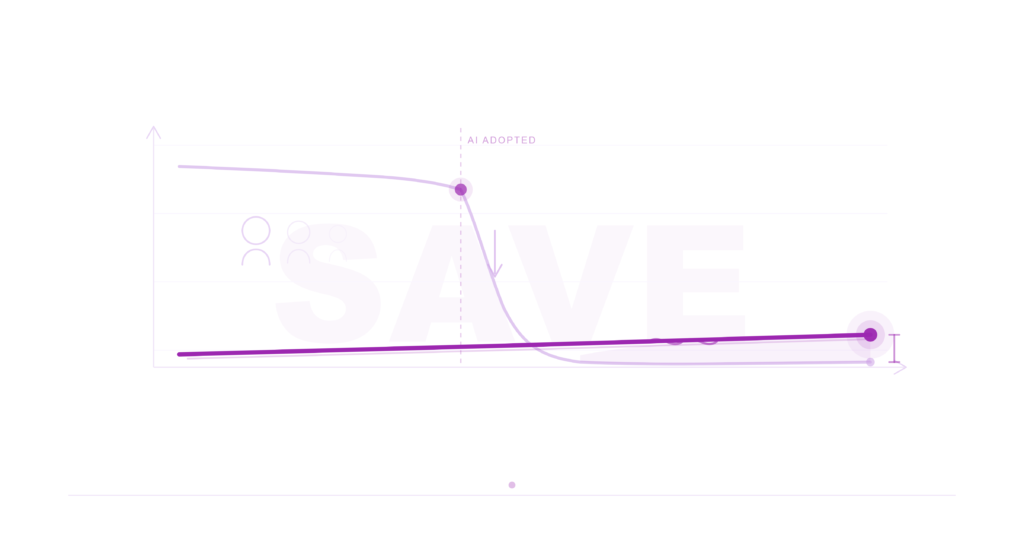
If you run finance or HR for a Saudi business, you already know the number on the offer letter is never the real number. A support agent earning SAR 5,000 a month does not cost you SAR 5,000 a month. By the time you add GOSI contributions, the expat levy, iqama fees, medical insurance, and a replacement every 18 to 24 months, that single seat can cost SAR 7,000 to 9,000 a month once everything is counted.
Multiply that by a team of ten, twenty, or fifty agents, and staffing stops being a line item. It becomes the single biggest number on your operating budget. This is exactly why more finance and HR leaders across the Kingdom are looking at AI voice agents, not as a trend, but as a serious lever to control one of their largest fixed costs.
This article breaks down where that cost actually comes from, what AI changes about it, and how to work out a realistic savings figure for your own team, using real Saudi numbers instead of generic global estimates.
The Real Cost of a Call Center Seat in Saudi Arabia
Most budget conversations start with basic salary. That is the smallest part of the story.
Here is what actually sits behind one expat support agent’s monthly cost in the Kingdom:
- Basic salary and housing allowance – the number everyone budgets for
- GOSI contribution – employers pay 2% of the contributory wage for expat occupational hazard insurance
- Expat levy (Maktab Amal fee) – SAR 700 to 800 per month, depending on your Saudization ratio
- Iqama issuance and renewal – SAR 650 a year, plus a SAR 51.75 processing fee through Absher Business
- Medical insurance – SAR 2,000 to 4,000 or more per year, and mandatory before the iqama is even issued
- Recruitment and onboarding – agency fees, training time, and ramp-up before the agent hits full productivity
- Turnover – expat turnover in the Saudi private sector runs 18 to 25% a year, and every departure means iqama disposal fees, a possible end-of-service payment, and the full cost of hiring a replacement again
Add it all up and the true cost of an agent typically lands 35 to 60% above the basic salary figure on the offer letter. For a team of 50, replacement cycles alone can add SAR 50,000 to 100,000 a year in administrative cost, before you even count the lost productivity of an empty seat.
For a Saudi national hired against your Nitaqat quota, the math looks different but is not necessarily cheaper. GOSI for a Saudi employee runs 11.75% employer-side, plus SANED unemployment contributions, plus end-of-service gratuity that accrues silently until the day they leave. A 10-year employee on SAR 15,000 a month can leave you with roughly SAR 112,500 in gratuity due at exit, a liability most budgets never see coming because it is not paid monthly.
This is the part most global articles on AI and call centers skip entirely. They talk about “labor costs” in the abstract. In Saudi Arabia, labor cost is a stack of specific, recurring government fees layered on top of salary, and it grows every time you add a seat.
Why This Cost Keeps Climbing
Three things make Saudi call center staffing harder to control than in most markets:
Seasonal demand spikes. Ramadan, Hajj, and Eid periods bring surges in call volume across retail, healthcare, and government-adjacent services. Most businesses either overstaff for months to prepare for a few weeks of peak demand, or understaff and lose customers to long hold times.
Saudization pressure. Nitaqat compliance is not optional. Falling into the wrong band restricts your ability to bring in new expat visas at all, which means your workforce planning has to account for compliance, not just cost.
High turnover in repetitive roles. Call center work is repetitive by design. Agents spend their day answering the same five questions, and that repetition drives the burnout that fuels the 18 to 25% annual turnover rate. Every resignation resets your recruitment and training clock.
None of these pressures are going away on their own. That is what is pushing HR and finance teams to look at automation as a structural fix, not a stopgap.
Where AI Actually Reduces Staffing Cost
AI voice agents do not save money by being a novelty. They save money by removing specific, measurable cost drivers from your staffing budget. Here is where the reduction actually happens.
1. Tier-1 call deflection
Most inbound call volume is not complex. Appointment bookings, order status checks, business hours, pricing questions, and basic account inquiries make up 60 to 70% of a typical queue. These calls do not need judgment or empathy. They need a fast, accurate answer.
An AI voice agent can handle these end to end, 24 hours a day, without a shift schedule. Every call it resolves is a call your human team never has to staff for, which means you can grow call volume without growing headcount at the same rate.
2. No overtime, no shift differentials, no night staffing
Running a support line around the clock in Saudi Arabia typically means hiring for night shifts, paying differentials, and still dealing with the highest attrition on that particular shift. An AI agent answers a call at 3 AM exactly the way it answers a call at 3 PM. No shift premium, no staffing gap, no burnout on the graveyard rotation.
3. Lower turnover, because the repetitive work is gone
When AI absorbs the high-volume, low-complexity calls, the humans who remain spend their day on the interactions that actually need a person: complex complaints, high-value clients, and situations that require judgment. This is more engaging work, and engaged agents stay longer. Fewer resignations mean fewer replacement cycles, and every replacement cycle you avoid saves you the iqama, recruitment, and training cost of starting over.
4. No visa or iqama overhead for growth
This is the part that matters most for a Saudi budget specifically. Scaling a human team means scaling visas, iqama issuance, GOSI contributions, and levy payments in lockstep with call volume. Scaling an AI voice agent means adjusting a subscription. There is no block visa application, no Nitaqat recalculation, and no new dependent levy every time your customer base grows.
5. Faster resolution, fewer repeat contacts
Repeat contacts are one of the most overlooked cost drivers in any call center. A customer who calls back because their first issue was not resolved costs you roughly the same as two separate calls. AI systems that access account data instantly and give consistent answers reduce the back-and-forth that creates repeat volume, which lowers total call load across the board.
Human Agent vs AI Voice Agent: A Real Cost Comparison
| Cost Factor | Human Agent (Expat, Saudi Arabia) | AI Voice Agent |
|---|---|---|
| Base monthly cost | SAR 5,000–8,000 salary | Fixed monthly subscription, no per-seat salary |
| GOSI, levy, iqama, insurance | Adds 35–60% on top of salary | None |
| Availability | Fixed shifts, overtime for 24/7 coverage | 24/7 by default, no shift premium |
| Onboarding time | Weeks of training before full productivity | Live in hours to days once configured |
| Turnover risk | 18–25% annual turnover in KSA | None, no recruitment cycle |
| Cost to scale | Every new seat repeats the full hiring and visa process | Scales with call volume, not headcount |
| Handles Saudi dialect | Yes, if hired locally | Only if the platform is built specifically for Gulf Arabic |
The point of this table is not that AI wins on every row. Judgment, empathy, and complex problem-solving still belong to your human team. The point is that the rows where AI wins are exactly the rows where your budget is currently bleeding the most.
What AI Should Not Replace
This is worth saying plainly, because it is where a lot of cost-cutting plans go wrong: AI is not a headcount elimination tool. It is a headcount efficiency tool.
The businesses that get this wrong cut staff before their automation is proven, then get caught flat-footed during a volume spike with no buffer and no fallback. The businesses that get it right use AI to absorb the routine 60 to 70% of call volume, let natural attrition shrink the team that handles it, and keep their best people focused on complaints, negotiations, and relationship-driven conversations that a machine should not be handling anyway.
There is also a compliance layer specific to Saudi Arabia that is easy to miss. Under the Personal Data Protection Law, customer voice data and call records need to be handled correctly, ideally with regional data residency. Any AI voice platform you evaluate should be able to answer, clearly, where your customers’ voice data is stored and processed.
A Simple Formula to Estimate Your Own Savings
You do not need a consultant to get a rough number. Use this:
Step 1: Take your fully loaded monthly cost per agent (salary + GOSI + levy + insurance + a share of recruitment cost). For most Saudi SMEs, this lands between SAR 7,000 and SAR 10,000 per expat agent.
Step 2: Estimate what percentage of your call volume is routine, Tier-1 work; appointment booking, order status, FAQs, basic account questions. Most support teams find this is 50 to 70% of total volume.
Step 3: Multiply your loaded cost per agent by the number of agents whose workload is dominated by that routine volume. That is your current spend on work an AI voice agent could realistically absorb.
Step 4: Compare that figure against the cost of an AI voice platform sized to your call volume, which for most SMEs in the Kingdom lands well below the cost of even one additional hire.
For a 10-agent support team where six agents are mostly handling routine calls, this formula commonly points to 30 to 50% in recoverable staffing cost, without cutting a single role on day one. It simply stops the next hire you were about to make.
Why Arabic Fluency Is the Part Most Businesses Get Wrong
Here is where a lot of AI deployments in this region quietly fail: they are built on generic, translated Arabic, and Saudi callers notice immediately. Modern Standard Arabic sounds stiff and formal on a phone call. Saudi customers speak in dialect, mix in English words mid-sentence, and expect a natural back-and-forth, not a script.
This is the exact gap ehlan.ai was built to close. Ehlan.ai is a Saudi-built AI voice agent platform that understands and responds in natural Saudi dialect, handles the code-switching between Arabic and English that real conversations actually involve, and answers on your existing phone number so the caller never feels like they have reached a machine. Clinics, service businesses, and sales teams using it report cutting effective reception and support costs by 40 to 70% while keeping calls answered instantly, 24 hours a day, including after hours and during Ramadan or Eid volume spikes when human staffing is hardest to manage. Because it plugs into your existing phone line and CRM without an IT project, teams are typically live within hours, not months.
For a finance or HR leader building next year’s budget, this is the practical version of everything above: the same cost structure problem every Saudi business faces, solved with a platform that was actually built for how Saudi customers talk.
Getting Started Without Overcommitting
You do not need to automate your entire call center on day one, and you should not.
- Pick one or two call types that are high-volume and low-complexity, appointment booking is usually the easiest starting point.
- Measure deflection and satisfaction together. A call resolved by AI that comes back as a complaint is not a win. Track both numbers from week one.
- Let attrition do the headcount work. Do not lay off agents to prove the ROI. Stop backfilling roles as the routine workload shrinks.
- Expand once the data holds up. Add call types gradually, and keep a clear escalation path to a human for anything the AI should not be handling.
This approach protects you from the two most common mistakes: cutting staff too early, and deploying AI on a call type it was never suited for.
Frequently Asked Questions
How much can AI actually reduce call center staffing costs in Saudi Arabia?
Most businesses that automate their routine, Tier-1 call volume see a 30 to 50% reduction in the staffing cost tied to that workload, without cutting existing roles. The saving typically comes from not backfilling positions and avoiding new hires as call volume grows.
Does AI replace human call center agents entirely?
No. AI voice agents are built to absorb high-volume, repetitive calls, not the complex, emotionally sensitive, or judgment-heavy conversations that still need a person. The businesses that see the best results use AI and human agents together, not one instead of the other.
Is an AI voice agent expensive to set up for a Saudi business?
Compared to the visa, iqama, GOSI, and recruitment cost of hiring even one additional agent, most AI voice platforms cost significantly less to deploy, and can go live within hours since they connect to your existing phone line and systems.
Can AI voice agents actually understand Saudi Arabic dialect?
Generic AI tools built on Modern Standard Arabic often struggle with Gulf dialect and Arabic-English code-switching. Platforms built specifically for the Saudi market, like ehlan.ai, are trained on real dialect and natural conversation patterns rather than translated scripts.
What is the biggest hidden cost in Saudi call center staffing?
Turnover. Expat attrition in the private sector runs 18 to 25% a year, and every departure triggers a new recruitment cycle, iqama costs, and weeks of lost productivity while the replacement ramps up. Reducing repetitive workload is one of the most effective ways to reduce this turnover.
The Bottom Line
Call center staffing in Saudi Arabia is not just a salary line. It is a stack of GOSI contributions, expat levies, iqama fees, insurance, and turnover that grows every time you add a seat. AI voice agents do not remove your team, they remove the routine, repetitive workload that drives most of that cost and most of that turnover in the first place.
For finance and HR leaders building next year’s budget, the question is no longer whether AI belongs in the conversation. It is which calls you automate first, and how quickly your team can start feeling the difference.

As a contributor to the Ehlan.ai blog, Hassan bridges the gap between marketing strategy and AI voice technology — helping business leaders understand how to attract, engage, and convert customers in a world where automation is the new competitive advantage. His content is built on real campaign experience, regional market knowledge, and a deep understanding of how AI is transforming the way brands communicate.
When he's not writing, Hassan is tracking the latest from Riyadh's fast-growing AI and tech scene — bringing the most relevant insights directly to the Ehlan.ai community.
- LEAP 2026 Saudi Arabia Review: What Really Happened and What It Means for Your Business - September 10, 2026
- Ehlan.ai AI Voice Agents vs Human Receptionists: Cost Comparison in KSA - September 6, 2026
- KSA Business Problems That AI Voice Agents Solve - August 31, 2026